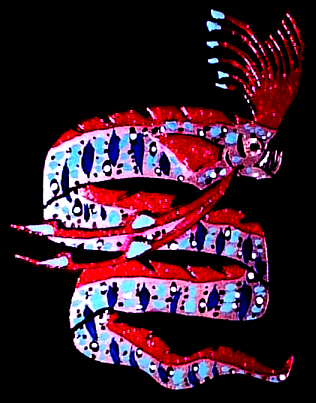
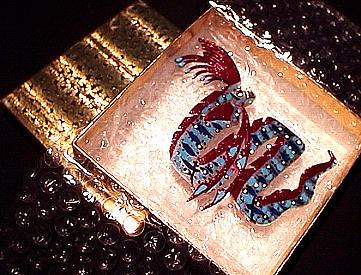
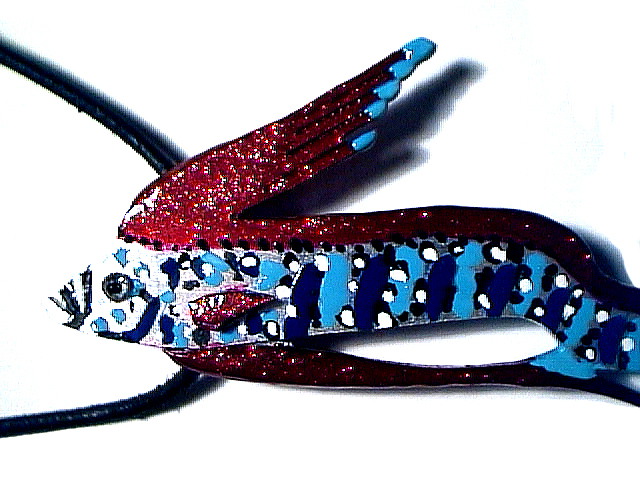
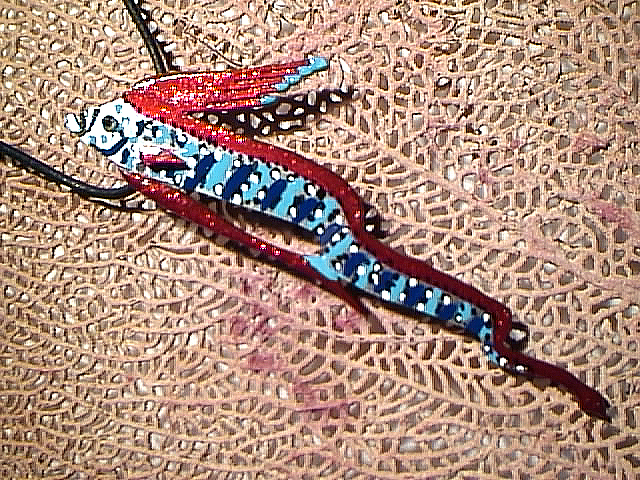
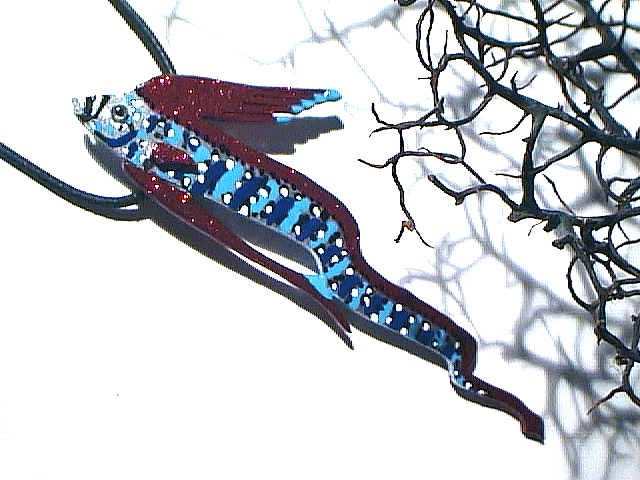
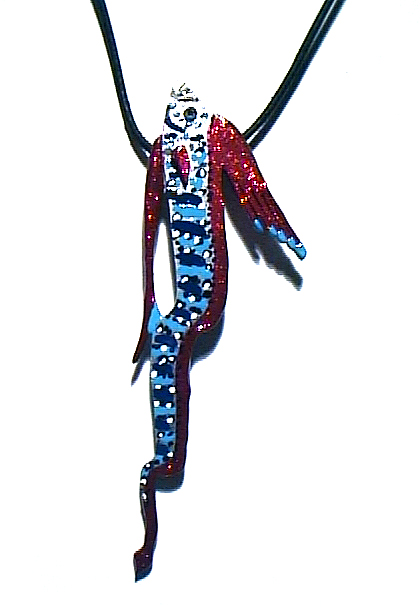
JCC JEWELRY OARFISH
BROOCH AND PENDANT...A COMMEMORATIVE PIN AND
NECKLACE...
I
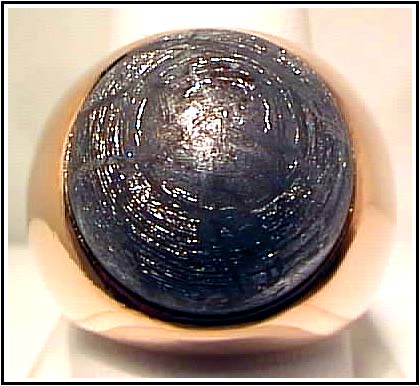
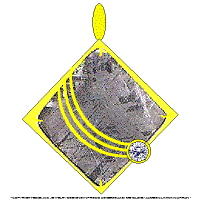
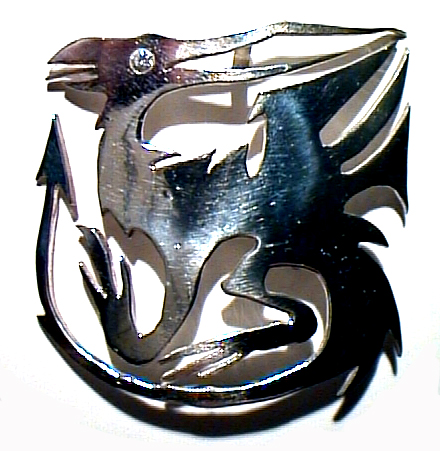
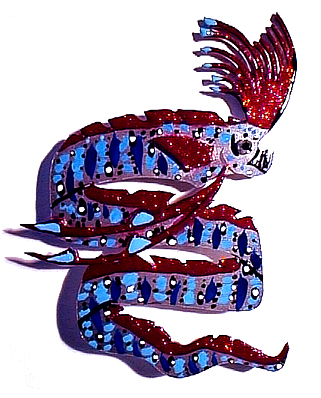
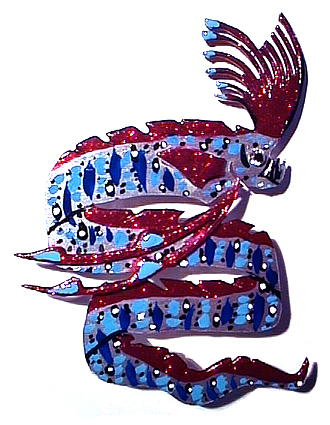
just created this beautiful, unique brooch and
pendant to commemorate the recent sightings of
oarfish seen around the world. Oarfish Jewelry
has never been created until now. Oarfish are the
largest bony fish in the sea and have been seen
as large as 56 feet long. According to the
ancient Japanese Oarfish are the "Messengers
from the Sea God's Palace." Also considered
royal because they are the King of
Herrings", also thought to be behind all the
sea serpent legends. The paradox being is that
the oarfish is a most beautiful, docile and
harmlessly innocent creature. Recently oarfish
have been seen washed up on the shores of Japan
and most recently Sweden. They are considered the
harbinger of earthquake disasters to come...JAMES CLINTON CURRAN...May and September 2010
(Please read more below).
HISTORY of the MYSTERIOUS OARFISH
...Oarfish...are large, greatly
elongated, pelagic Lampriform fishes comprising
the small family Regalecidae. Found in all
temperate to tropical oceans yet rarely seen, the
oarfish family contains four species in two
genera. One of these, the king of herrings
(Regalecus glesne), is listed in the Guinness
Book of World Records as the longest bony fish
alive, at up to 17 metres (56 ft) in length. The
common name oarfish is presumably in reference to
either their highly compressed and elongated
bodies, or to the former (but now discredited)
belief that the fish "row" themselves
through the water with their pelvic fins. The
family name Regalecidae is derived from the Latin
regalis, meaning "royal". The
occasional beachings of oarfish after storms, and
their habit of lingering at the surface when sick
or dying, make oarfish a probable source of many
sea serpent tales. Although the larger species
are considered game fish and are (to a minor
extent) fished commercially, oarfish are rarely
caught alive; their flesh is not well regarded
due to its gelatinous consistency.
...Anatomy and morphology...The tapering, ribbony
silver bodies of oarfish together with an
impressive, pinkish to cardinal red dorsal fin
help explain the perception of majesty taken from
rare encounters. The dorsal fin originates from
above the (relatively small) eyes and runs the
entire length of the fish. Of the approximately
400 dorsal fin rays, the first 10 to 12 are
elongated to varying degrees, forming a trailing
crest embellished with reddish spots and flaps of
skin at the ray tips. The pelvic fins are
similarly elongated and adorned, reduced to 1 to
5 rays each. The pectoral fins are greatly
reduced and situated low on the body. The anal
fin is completely absent and the caudal fin may
be reduced or absent as well, with the body
tapering to a fine point. All fins lack true
spines. At least one account, from researchers in
New Zealand, describes the oarfish as giving off
"electric shocks" when touched. Like
other members of its order, the oarfish has a
small yet highly protrusible oblique mouth with
no visible teeth. The body is scaleless and the
skin covered with easily abraded, silvery
guanine. In the streamer fish (Agrostichthys
parkeri), the skin is clad with hard tubercles.
All species lack gas bladders and the number of
gill rakers is variable. Oarfish coloration is
also variable; the flanks are commonly covered
with irregular bluish to blackish streaks, black
dots, and squiggles. These markings quickly fade
following death. The king of herrings is by far
the largest member of the family at a published
total length of 11 meters (with unconfirmed
reports of 15 meters or more) and 272 kilograms
in weight. The streamer fish is known to reach 3
meters total length whilst the largest recorded
specimen of Regalecus russelii measured just 5.5
centimeters standard length. It is probable that
this little-known species can regularly reach a
maximum length of at least 15.2 meters (50 ft).
...Distribution...The members of the family
are known to have a worldwide range. However,
specific encounters with live individuals in situ
are rare and distribution information is collated
from records of oarfishes caught or washed
ashore.
...Ecology and life history...Rare encounters with
divers and accidental catches have supplied what
little is known of oarfish behavior and ecology.
Apparently solitary animals, oarfish may frequent
significant depths up to 1,000 metres (3,300 ft).
A photograph on display in bars, restaurants,
guesthouses, and markets around Thailand that is
captioned, "Queen of Nagas seized by
American Army at Mekhong River, Laos Military
Base on June 27, 1973 with the length of 7.80
meters," is a hoax. The photograph is
actually that taken by USN LT DeeDee Van Wormer,
of an oarfish found in late 1996 by US Navy SEAL
trainees on the coast of Coronado, California. A
catch of an 11 ft 4 in (3.3 metres), 140 lb
(63.5kg) monster that turned out to be an oarfish
was reported on 17 February 2003 by Ms Val
Fletcher, who was using a fishing rod baited with
squid, at Skinningrove, a coastal settlement of
north-east England. In 2001 an oarfish was filmed
alive and in situ: the 1.5 meter fish was spotted
by a group of US Navy personnel during the
inspection of a buoy in the Bahamas. The oarfish
was observed to propel itself via an amiform mode
of swimming; that is, rhythmically undulating the
dorsal fin whilst keeping the body itself
straight. Perhaps indicating a feeding posture,
oarfish have been observed swimming in a vertical
orientation, with their long axis perpendicular
to the ocean surface. In this posture the
downstreaming light would silhouette the
oarfishes' prey, making them easier to spot.
...Behavior...In July 2008, Canadian Researcher
William Sommers captured footage of the rare fish
swimming in its natural habitat off the Gulf of
Mexico. It is the first ever confirmed sighting
of an oarfish at depth, as most specimens are
discovered dying at the sea surface or washed
ashore. The fish was estimated to be between 5m
and 10m in length. From December 2009 through
March 2010, unusual numbers of the slender
oarfish Regalecus russelii / Ryu-gu--No-Tsukai,)
known in Japanese folklore as the Messenger from
the Sea God's Palace, have appeared in the waters
and on the beaches of Japan; the appearance of
which is said to portend earthquakes.
...Feeding ecology...Oarfish feed primarily on
zooplankton, selectively straining tiny
euphausiids, shrimp, and other crustaceans from
the water. Small fish, jellyfish, and squid are
also taken. Large open-ocean carnivores are all
likely predators of oarfish, and include the
Oceanic whitetip shark. Oarfish have no visible
teeth.
...Life
history...The
oceanodromous Regalecus glesne is recorded as
spawning off Mexico from July to December; all
species are presumed to be non-guarders and
release brightly coloured, buoyant eggs, up to 6
millimetres (0.24 in) across, which are
incorporated into the zooplankton. The eggs hatch
after about three weeks into highly active
larvae, that feed on other zooplankton. The
larvae have little resemblance to the adults,
with long dorsal and pelvic fins and extensible
mouths. Larvae and juveniles have been observed
drifting just below the surface. In contrast,
adult oarfish are rarely seen at the surface when
not sick or injured.
|
|