 |
 |
 |
|
|
|
| READ THE BOOK: JULES VERNE'S TWENTY THOUSAND LEAGUES UNDER THE SEA ILLUSTRATED BY JAMES CLINTON CURRAN |
| RETURN TO TWENTY THOUSAND LEAGUES UNDER THE SEA |
READ THIS BOOK HERE BELOW: JULES VERNE'S TWENTY THOUSAND LEAGUES UNDER THE SEA ILLUSTRATED BY JAMES CLINTON CURRAN
PART ONE CHAPTER XI. ALL BY ELECTRICITY. ___"Sir," said Captain Nemo, showing me the instruments hanging on the walls of his room, "here are the contrivances required for the navigation of the Nautilus. Here, as in the drawing room, I have them always under my eyes, and they indicate my position and exact direction in the middle of the ocean. Some are known to you, such as the thermometer, which gives the internal temperature of the Nautilus; the barometer, which indicates the weight of the air and foretells the changes of the weather; the hygrometer, which marks the dryness of the atmosphere; the storm glass, the contents of which, by decomposing, announce the approach of tempests; the compass, which guides my course; the sextant, which shows the latitude by the altitude of the sun; chronometers, by which I calculate the longitude; and glasses for day and night, which I use to examine the points of the horizon, when the Nautilus rises to the surface of the waves." "These are the usual nautical instruments," I replied, "and I know the use of them. But these others, no doubt, answer to the particular requirements of the Nautilus. This dial with the movable needle is a manometer, is it not?" "It is actually a manometer. But by communication with the water, whose external pressure it indicates, it gives our depth at the same time." "And these other instruments, the use of which I cannot guess?" "Here, Professor, I ought to give you some explanations. Will you be kind enough to listen to me?" He was silent for a few moments, then he said: "There is a powerful agent, obedient, rapid, easy, which conforms to every use, and reigns supreme on board my vessel. Everything is done by means of it. It lights it, warms it, and is the soul of my mechanical apparatus. This agent is electricity." "Electricity?" I cried in surprise. "Yes, Sir." "Nevertheless, Captain, you possess an extreme rapidity of movement, which does not agree well with the power of electricity. Until now, its dynamic force has remained under restraint, and has only been able to produce a small amount of power." "Professor," said Captain Nemo, "my electricity is not everybody's. You know what sea water is composed of. In a thousand grams are found 96 1/2 per cent of water, and about 2 2/3 per cent of chloride of sodium; then, in a smaller quantity, chlorides of magnesium and of potassium, bromide of magnesium, sulphate of magnesia, sulphate and carbonate of lime. You see, then, that chloride of sodium forms a large part of it. So it is this sodium that I extract from sea water, and of which I compose my ingredients, I owe all to the ocean; it produces electricity, and electricity gives heat, light, motion, and, in a word, life to the Nautilus." "But not the air you breathe?" "Oh! I could manufacture the air necessary for my consumption, but it is useless, because I go up to the surface of the water when I please. However, if electricity does not furnish me with air to breathe, it works at least the powerful pumps that are stored in spacious reservoirs, and which enable me to prolong at need, and as long as I will, my stay in the depths of the sea. It gives a uniform and unintermittent light, which the sun does not. Now look at this clock; it is electrical, and goes with a regularity that defies the best chronometers. I have divided it into twenty-four hours, like the Italian clocks, because for me there is neither night nor day, sun nor moon, but only that factitious light that I take with me to the bottom of the sea. Look! just now, it is ten o'clock in the morning." "Exactly." "Another application of electricity. This dial hanging in front of us indicates the speed of the Nautilus. An electric thread puts it in communication with the screw, and the needle indicates the real speed. Look now we are spinning along with a uniform speed of fifteen miles an hour." "It is marvelous! and I see, Captain, you were right to make use of this agent that takes the place of wind, water, and steam." "We have not finished, M. Aronnax," said Captain Nemo, rising; "if you will follow me, we will examine the stern of the Nautilus." Really, I knew already the anterior part of this submarine boat, of which this is the exact division, starting from the ship's head: the dining room, five yards long, separated from the library by a water-tight partition; the library, five yards long; the large drawing room, ten yards long, separated from the captain's room by a second watertight partition; the said room, five yards in length; mine, two and a half yards; and lastly, a reservoir of air, seven and a half yards, that extended to the bows. Total length thirty-five yards, or one hundred five feet. The partitions had doors that were shut hermetically by means of India-rubber instruments, and they insured the safety of the Nautilus in case of a leak. I followed Captain Nemo through the waist, and arrived at the center of the boat. There was a sort of well that opened between two partitions. An iron ladder, fastened with an iron hook to the partition, led to the upper end. I asked the captain what the ladder was used for. "It leads to the small boat," he said. "What! have you a boat?" I exclaimed, in surprise. "Of course; an excellent vessel, light and insubmersible, that serves either as a fishing or as a pleasure boat." "But then, when you wish to embark, you are obliged to come to the surface of the water?" "Not at all. This boat is attached to the upper part of the hull of the Nautilus, and it occupies a cavity made for it. It is decked, quite water-tight, and held together by solid bolts. This ladder leads to a manhole made in the hull of the Nautilus, that corresponds with a similar hole made in the side of the boat. By this double opening I get into the small vessel. They shut the one belonging to the Nautilus, I shut the other by means of screw pressure. I undo the bolts, and the little boat goes up to the surface of the sea with prodigious rapidity. I then open the panel of the bridge, carefully shut till then; I mast it, hoist my sail, take my oars, and I'm off." "But how do you get back on board?" "I do not come back, M. Aronnax; the Nautilus comes to me." "By your orders?" "By my orders. An electric thread connects us. I telegraph to it, and that is enough." "Really," I said, astonished at these marvels, "nothing can be more simple." After having passed by the cage of the staircase that led to the platform, I saw a cabin six feet long, in which Conseil and Ned Land, enchanted with their repast, were devouring it with avidity. Then a door opened into a kitchen nine feet long, situated between the large storerooms. There electricity, better than gas itself, did all the cooking. The streams under the furnaces gave out to the sponges of platina a heat which was regularly kept up and distributed. They also heated a distilling apparatus, which, by evaporation, furnished excellent drinkable water. Near this kitchen was a bathroom comfortable furnished, with hot and cold water taps. Next to the kitchen was the berth room of the vessel, sixteen feet long. But the door was shut, and I could not see the management of it, which might have given me an idea of the number of men employed on board the Nautilus. At the bottom was a fourth partition that separated this office from the engine room. A door opened, and I found myself in the compartment where Captain Nemo- certainly an engineer of a very high order- had arranged his locomotive machinery. This engine room, clearly lighted, did not measure less than sixty-five feet in length. It was divided into two parts; the first contained the materials for producing electricity, and the second the machinery that connected it with the screw. I examined it with great interest, in order to understand the machinery of the Nautilus. "You see," said the captain, "I use Bunsen's contrivances, not Ruhmkorff's.Those would not have been powerful enough. Bunsen's are fewer in number, but strong and large, which experience proves to be the best. The electricity produced passes forward, where it works, by electromagnets of great size, on a system of levers and cogwheels that transmit the movement to the axle of the screw. This one, the diameter of which is nineteen feet, and the thread twenty-three feet, performs about a hundred twenty revolutions in a second." "And you get then?" "A speed of fifty miles an hour." "I have seen the Nautilus maneuver before the Abraham Lincoln, and I have my own ideas as to its speed. But this is not enough. We must see where we go.We must be able to direct it to the right, to the left, above, below. How do you get to the great depths, where you find an increasing resistance, which is rated by hundreds of atmospheres? How do you return to the surface of the ocean? And how do you maintain yourselves in the requisite medium? Am I asking too much?" "Not at all, Professor," replied the captain, with some hesitation; "since you may never leave this submarine boat. Come into the saloon, it is our usual study, and there you will learn all you want to know about the Nautilus." |
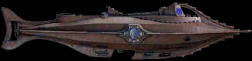
CHAPTER XII. SOME FIGURES. ___A moment after we were seated on a divan in the saloon smoking. The captain showed me a sketch that gave the plan, section, and elevation of the Nautilus.Then he began his description in these words: "Here, M. Aronnax, are the several dimensions of the boat you are in. It is an elongated cylinder with conical ends. It is very like a cigar in shape, a shape already adopted in London in several constructions of the same sort. The length of this cylinder, from stern to stern, is exactly 232 feet, and its maximum breadth is 26 feet. It is not built quite like your long-voyage steamers, but its lines are sufficiently long, and its curves prolonged enough, to allow the water to slide off easily, and oppose no obstacle to its passage. These two dimensions enable you to obtain by a simple calculation the surface and cubic contents of the Nautilus. Its area measures 6,032 feet; and its contents about 1,500 cubic yards; that is to say, when completely immersed it displaces 50,000 feet of water, or weighs 1,500 tons. "When I made the plans for this submarine vessel, I meant that nine tenths should be submerged; consequently it ought only to displace nine tenths of its bulk; that is to say, only to weigh that number of tons. I ought not, therefore, to have exceeded that weight, constructing it on the aforesaid dimensions. "The Nautilus is composed of two hulls, one inside, the other outside, joined by T-shaped irons, which render it very strong. Indeed, owing to this cellular arrangement it resists like a block, as if it were solid. Its sides cannot yield; it coheres spontaneously, and not by the closeness of its rivets; and the homogeneity of its construction, due to the perfect union of the materials, enables it to defy the roughest seas. "These two hulls are composed of steel plates, whose density is from .7 to .8 that of water. The first is not less than two inches and a half thick, and weighs 394 tons. The second envelope, the keel, twenty inches high and ten thick, weighs alone sixty-two tons. The engine, the ballast, the several accessories and apparatus appendages, the partitions and bulkheads, weigh 961.62 tons. Do you follow all this?" "I do." "Then, when the Nautilus is afloat under these circumstances, one tenth is out of the water. Now, if I have made reservoirs of a size equal to this tenth, or capable of holding 150 tons, and if I fill them with water, the boat, weighing then1,507 tons, will be completely immersed. That would happen, Professor. These reservoirs are in the lower parts of the Nautilus. I turn on taps and they fill, and the vessel sinks that had just been level with the surface." "Well Captain, but now we come to the real difficulty. I can understand your rising to the surface; but diving below the surface, does not your submarine contrivance encounter a pressure, and consequently undergo an upward thrust of one atmosphere for every thirty feet of water, just about fifteen pounds to a square inch?" "Just so, Sir." "Then, unless you quite fill the Nautilus, I do not see how you can draw it down to those depths." "Professor, you must not confound statics with dynamics, or you will be exposed to grave errors. There is very little labor spent in attaining the lower regions of the ocean, for all bodies have a tendency to sink. When I wanted to find out the necessary increase of weight required to sink the Nautilus, I had only to calculate the reduction of volume that sea water acquires according to the depth." "That is evident." "Now, if water is not absolutely incompressible, it is at least capable of very slight compression. Indeed, after the most recent calculations this reduction is only .000436 of an atmosphere for each thirty feet of depth. If we want to sink 3,000 feet, I should keep account of the reduction of bulk under a pressure equal to that of a column of water of a thousand feet. The calculation is easily verified. Now, I have supplementary reservoirs capable of holding a hundred tons. Therefore I can sink to a considerable depth. When I wish to rise to the level of the sea, I only let off the water, and empty all the reservoirs if I want the Nautilus to emerge from the tenth part of her total capacity." I had nothing to object to these reasonings. "I admit your calculations, Captain," I replied; "I should be wrong to dispute them since daily experience confirms them; I foresee a real difficulty in the way." "What, Sir?" "When you are about 1,000 feet deep, the walls of the Nautilus bear a pressure of 100 atmospheres. If, then, just now you were to empty the supplementary reservoirs, to lighten the vessel, and to go up to the surface, the pumps must overcome the pressure of 100 atmospheres, which is 1,500 lbs. to a square inch. From that a power ..." "That electricity alone can give," said the captain, hastily. "I repeat, Sir, that the dynamic power of my engines is almost infinite. The pumps of the Nautilus have an enormous power, as you must have observed when their jets of water burst like a torrent upon the Abraham Lincoln. Besides I use subsidiary reservoirs only to attain a mean depth of 750 to 1,000 fathoms, and that with a view of managing my machines. Also, when I have a mind to visit the depths of the ocean five or six miles below the surface, I make use of slower but not less infallible means." "What are they, Captain?" "That involves my telling you how the Nautilus is worked." "I am impatient to learn." "To steer this boat to starboard or port, to turn, in a word, following a horizontal plane, I use an ordinary rudder fixed on the back of the sternpost, and with one wheel and some tackle to steer by. But I can also make the Nautilus rise and sink,and sink and rise, by a vertical movement by means of two inclined planes fastened to its sides, opposite the center of flotation, planes that move in every direction, and that are worked by powerful levers from the interior. If the planes are kept parallel with the boat, it moves horizontally. If slanted, the Nautilus, according to this inclination, and under the influence of the screw, either sinks, diagonally or rises diagonally as it suits me. And even if I wish to rise more quickly to the surface, I ship the screw, and the pressure of the water causes the Nautilus to rise vertically like a balloon filled with hydrogen." "Bravo, Captain! But how can the steersman follow the route in the middle of the waters?" "The steersman is placed in a glazed box, that is raised above the hull of the Nautilus, and furnished with lenses." "Are these lenses capable of resisting such pressure?" "Perfectly. Glass, which breaks at a blow, is, nevertheless, capable of offering considerable resistance. During some experiments of fishing by electric light in 1864 in the northern seas, we saw plates less than a third of an inch thick resist a pressure of sixteen atmospheres. Now, the glass that I use is not less than thirty times thicker." "Granted. But, after all, in order to see, the light must exceed the darkness, and in the midst of the darkness in the water, how can you see?" "Behind the steersman's cage is placed a powerful electric reflector, the rays from which light up the sea for half a mile in front." "Ah! bravo, bravo, Captain! Now I can account for this phosphorescence in the supposed narwhal that puzzled us so. I now ask you if the boarding of the Nautilus and of the Scotia, that has made such a noise, has been the result of a chance rencontre?" "Quite accidental, Sir. I was sailing only one fathom below the surface of the water, when the shock came. It had no bad result." "None, Sir. But now, about your rencontre with the Abraham Lincoln?" "Professor, I am sorry for one of the best vessels in the American navy; but they attacked me, and I was bound to defend myself. I contented myself, however, with putting the frigate hors de combat: she will not have any difficulty in getting repaired at the next port." "Ah, Commander! your Nautilus is certainly a marvelous boat." "Yes, Professor; and I love it as if it were part of myself. If danger threatens one of your vessels on the ocean, the first impression is the feeling of an abyss above and below. On the Nautilus men's hearts never fail them. No defects to be afraid of, for the double shell is as firm as iron; no rigging to attend to; no sails for the wind to carry away; no boilers to burst; no fire to fear, for the vessel is made of iron, not of wood; no coal to run short, for electricity is the only mechanical agent; no collision to fear, for it alone swims in deep water; no tempest tobrave, for when it dives below the water, it reaches absolute tranquility. There, Sir! that is the perfection of vessels! And if it is true that the engineer has more confidence in the vessel than the builder, and the builder than the captain himself, you understand the trust I repose in my Nautilus; for I am at once, captain, builder, and engineer." "But how could you construct this wonderful Nautilus in secret?" "Each separate portion, M. Aronnax, was brought from different parts of the globe. The keel was forged at Creusot, the shaft of the screw at Penn & Co.'s, London, the iron plates of the hull at Laird's of Liverpool, the screw itself at Scott's at Glasgow. The reservoirs were made by Cail & Co. at Paris, the engine by Krupp in Prussia, its beak in Motala's workshop in Sweden, its mathematical instruments by Hart Brothers, of New York, etc.; and each of these people had my orders under different names." "But these parts had to be put together and arranged?" "Professor, I had set up my workshops upon a desert island in the ocean. There my workmen, that is to say, the brave men that I instructed and educated, and myself have put together our Nautilus. Then, when the work was finished, fire destroyed all trace of our proceedings on this island, that I could have jumped over if I had liked." "Then the cost this vessel is great?" "M. Aronnax, an iron vessel costs L45 a ton. Now the Nautilus weighed 1,500. It came therefore to L67,500, and L80,000 more for fitting it and about L200,000 with the works of art and the collections it contains." "One last question, Captain Nemo." "Ask it, Professor." "You are rich?" "Immensely rich, Sir; and I could, without missing it, pay the national debt of France." I stared at the singular person: who spoke thus. Was he playing upon my credulity? The future would decide that. |
CHAPTER XIII. THE BLACK RIVER. ___The portion of the terrestrial globe which is covered by water is estimated at upwards of eighty millions of acres. This fluid mass comprises two billions two hundred fifty millions of cubic miles, forming a spherical body of a diameter of sixty leagues, the weight of which would be three quintillions of tons. To comprehend the meaning of these figures, it is necessary to observe that a quintillion is to a billion as a billion is to unity; in other words, there are as many billions in a quintillion as there are units in a billion. This mass of fluid is equal to about the quantity of water which would be discharged by all the rivers of the earth in forty thousand years. During the geological epochs, the igneous period succeeded to the aqueous.The ocean originally prevailed everywhere. Then by degrees, in the silurian period, the tops of the mountains began to appear, the islands emerged, then disappeared in partial deluges, reappeared, became settled, formed continents, till at length the earth became geographically arranged, as we see in the present day.The solid had wrested from the liquid thirty-seven million six hundred fifty-seven square miles, equal to twelve billions nine hundred sixty millions of acres. The shape of continents allows us to divide the waters into five great portions:the Arctic or Frozen Ocean, the Antarctic or Frozen Ocean, the Indian, the Atlantic, and the Pacific Oceans. The Pacific Ocean extends from north to south between the two polar circles, and from east to west between Asia and America, over an extent of 145 degrees of longitude. It is the quietest of seas; its currents are broad and slow; it has medium tides, and abundant rain. Such was the ocean that my fate destined me first to travel over under these strange conditions. "Sir," said Captain Nemo, "we will, if you please, take our bearings and fix the starting point of this voyage. It is a quarter to twelve, I will go up again to the surface." The Captain pressed an electric clock three times. The pumps began to drive the water from the tanks; the needle of the manometer marked by a different pressure the ascent of the Nautilus, then it stopped. "We have arrived," said the Captain. I went to the central staircase which opened on to the platform, clambered up the iron steps, and found myself on the upper part of the Nautilus. The platform was only three feet out of water. The front and back of the Nautilus were of that spindle shape which caused it justly to be compared to a cigar. I noticed that its iron plates, slightly overlaying one another, resembled the shell which clothes the bodies of our large terrestrial reptiles. It explained to me how natural it was, in spite of all glasses, that this boat should have been taken for a marine animal. Toward the middle of the platform, the longboat, half buried in the hull of the vessel, formed a slight excrescence. Fore and aft rose two cages of medium height with inclined sides, and partly closed by thick lenticular glasses; one destined for the steersman who directed the Nautilus the other containing a brilliant lantern to give light on the road. The sea was beautiful, the sky pure. Scarcely could the long vehicle feel the broad undulations of the ocean. A light breeze from the east rippled the surface of the waters. The horizon, free from fog, made observation easy. Nothing was in sight. Not a quicksand, not an island. A vast desert. Captain Nemo, by the help of his sextant, took the altitude of the sun, which ought also to give the latitude. He waited for some moments till its disc touched the horizon. While taking observations, not a muscle moved, the instrument could not have been more motionless in a hand of marble. "Twelve o'clock, sir," said he. "When you like" I cast a last look upon the sea, slightly yellowed by the Japanese coast, and descended to the saloon. "And now, sir, I leave you to your studies," added the captain; "our course is E.N.E., our depth is twenty-six fathoms. Here are maps on a large scale by which you may follow it. The saloon is at your disposal, and with your permission I will retire." Captain Nemo bowed, and I remained alone, lost in thoughts all bearing on the commander of the Nautilus. For a whole hour was I deep in these reflections, seeking to pierce this mystery so interesting to me. Then my eyes fell upon the vast planisphere spread upon the table, and I placed my finger on the very spot where the given latitude and longitude crossed. The sea has its large rivers like the continents. They are special currents known by their temperature and their color. The most remarkable of these is known by the name of the Gulf Stream. Science has decided on the globe the direction of five principal currents: one in the North Atlantic, a second in the South, a third in the North Pacific, a fourth in the South, and a fifth in the southern Indian Ocean. It is even probable that a sixth current existed at one time or another in the northern Indian Ocean, when the Caspian and Aral seas formed but one vast sheet of water. At this point indicated on the planisphere, one of these currents was rolling the Kuro-Scivo of the Japanese, the Black River which, leaving the Gulf of Bengal where it is warmed by the perpendicular rays of a tropical sun, crosses the Straits of Malacca along the coast of Asia, turns into the North Pacific to the Aleutian Islands, carrying with it trunks of camphor trees and other indigenous productions, and edging the waves of the ocean with the pure indigo of its warm water.It was this current that the Nautilus was to follow. I followed it with my eye; sawit lose itself in the vastness of the Pacific, and felt myself drawn with it, when Ned Land and Conseil appeared at the door of the saloon. My two brave companions remained petrified at the sight of the wonders spread before them. "Where are we, where are we?" exclaimed the Canadian. "In the Museum at Quebec?" "My friends," I answered, making a sign for them to enter, "you are not in Canada, but on board the Nautilus fifty yards below the level of the sea." "But, M. Aronnax," said Ned Land, "can you tell me how many men there are on board? Ten, twenty, fifty, a hundred?" "I cannot answer you, Mr. Land; it is better to abandon for a time all idea of seizing the Nautilus or escaping from it. This ship is a masterpiece of modern industry, and I should be sorry not to have seen it. Many people would accept the situation forced upon us, if only to move among such wonders. So be quiet and let us try and see what passes around us." "See!" exclaimed the harpooner, "but we can see nothing in this iron prison! We are walking, we are sailing blindly." Ned Land had scarcely pronounced these words when all was suddenly darkness. The luminous ceiling was gone, and so rapidly that my eyes received a painful impression. We remained mute, not stirring, and not knowing what surprise awaited us, whether agreeable or disagreeable. A sliding noise was heard: one would have said that panels were working at the sides of the Nautilus. "It is the end of the end!" said Ned land. Suddenly light broke at each side of the saloon, through two oblong openings.The liquid mass appeared vividly lit up by the electric gleam. Two crystal plates separated us from the sea. At first I trembled at the thought that this frail partition might break, but strong bands of copper bound them, giving an almost infinite power of resistance. The sea was distinctly visible for a mile all round the Nautilus. What a spectacle! What pen can describe it? Who could paint the effects of the light through those transparent sheets of water, and the softness of the successive gradations from the lower to the superior strata of the ocean? We know the transparency of the sea, and that its clearness is far beyond that of rock water. The mineral and organic substances, which it holds in suspension, heightens its transparency. In certain parts of the ocean at the Antilles, under seventy-five fathoms of water, can be seen with surprising clearness a bed of sand.The penetrating power of the solar rays does not seem to cease for a depth of one hundred fifty fathoms. But in this middle fluid traveled over by the Nautilus, the electric brightness was produced even in the bosom of the waves. It was no longer luminous water, but liquid light. On each side a window opened into this unexplored abyss. The obscurity of the saloon showed to advantage the brightness outside, and we looked out as if this pure crystal had been the glass of an immense aquarium. "You wished to see, friend Ned; well, you see now." "Curious! curious!" muttered the Canadian, who, forgetting his ill temper, seemed to submit to some irresistible attraction; "and one would come farther than this to admire such a sight!" "Ah!" thought I to myself, "I understand the life of this man; he has made a world apart for himself, in which he treasures all his greatest wonders." For two whole hours an aquatic army escorted the Nautilus. During their games, their bounds, while rivaling one another in beauty, brightness, and velocity, I distinguished the green labre; the banded mullet, marked by a double line of black; the round-tailed goby, of a white color, with violet spots on the back; the Japanese scombrus, a beautiful mackerel of these seas, with a blue, body and silvery head; the brilliant azurors, whose name alone defies description; some banded spares, with variegated fins of blue and yellow; some aclostons, the woodcocks of the seas, some specimens of which attain a yard in length; Japanese salamanders, spider lampreys, serpents six feet long, with eyes small and lively, and a huge mouth bristling with teeth; with many other species. Our imagination was kept at its height, interjections followed quickly on one another. Ned named the fish, and Conseil classed them. I was in ecstasies with thevivacity of their movements and the beauty of their forms. Never had it been given to me to surprise these animals, alive and at liberty, in their natural element.I will not mention all the varieties which passed before my dazzled eyes, all the collection of the seas of China and Japan. These fish, more numerous than the birds of the air, came, attracted, no doubt, by the brilliant focus of the electric light. Suddenly there was daylight in the saloon, the iron panels closed again, and the enchanting vision disappeared. But for a long time I dreamt on till my eyes fell on the instruments hanging on the partition. The compass still showed the course to be E.N.E., the manometer indicated a pressure of five atmospheres, equivalent to a depth of twenty-five fathoms, and the electric log gave a speed of fifteen miles an hour. I expected Captain Nemo, but he did not appear. The clock marked the hour of five. Ned Land and Conseil returned to their cabin, and I retired to my chamber.My dinner was ready. It was composed of turtle soup made of the most delicate hawks-bills, of a surmullet served with puff paste (the liver of which, prepared by itself, was most delicious), and fillets of the emperor-holacanthus, the savor of which seemed to me superior even to salmon. I passed the evening reading, writing, and thinking. Then sleep overpowered me, and I stretched myself on my couch of zostera, and slept profoundly, while the Nautilus was gliding rapidly through the current of the Black River. |
CHAPTER XIV. A NOTE OF INVITATION. ___The next day was November 9. I awoke after a long sleep of twelve hours.Conseil came, according to custom, to know "how I had passed the night," and to offer his services. He had left his friend the Canadian sleeping like a man who had never done anything else all his life. I let the worthy fellow chatter as he pleased, without caring to answer him. I was preoccupied by the absence of the captain during our sitting of the day before, and hoping to see him today. As soon as I was dressed, I went into the saloon. It was deserted. I plunged into the study of the conchological treasures hidden behind the glasses. I reveled also in great herbals filled with the rarest marine plants, which, although dried up, retained their lovely colors. Among these precious hydrophytes I remarked some vorticellae, pavonariae, delicate ceramies with scarlet tints, some fan-shaped agari, and some natabuli like flat mushrooms, which at one time used to be classed as zoophytes; in short, a perfect series of algae. The whole day passed without my being honored by a visit from Captain Nemo. The panels of the saloon did not open. Perhaps they did not wish us to tire of these beautiful things. The course of the Nautilus was E.N.E., her speed twelve knots, the depth below the surface between twenty-five and thirty fathoms. The next day, November 10, the same desertion, the same solitude. I did not see one of the ship's crew. Ned and Conseil spent the greater part of the day with me. They were astonished at the inexplicable absence of the captain. Was this singular man ill? Had he altered his intentions with regard to us? After all, as Conseil said, we enjoyed perfect liberty, we were delicately and abundantly fed. Our host kept to his terms of the treaty. We could not complain, and, indeed, the singularity of our fate reserved such wonderful compensation for us, that we had no right to accuse it as yet. That day I commenced the journal of these adventures which has enabled me to relate them with more scrupulous exactitude and minute detail. I wrote it on paper made from the zosteria marina. November 11, early in the morning. The fresh air spreading over the interior of the Nautilus told me that we had come to the surface of the ocean to renew our supply of oxygen. I directed my steps to the central staircase, and mounted the platform. It was six o'clock, the weather was cloudy, the sea gray but calm. Scarcely a billow. Captain Nemo, whom I hoped to meet, would he be there? I saw no one but the steersman imprisoned in his glass cage. Seated upon the projection formed by the hull of the pinnace, I inhaled the salt breeze with delight. By degrees the fog disappeared under the action of the sun's rays, the radiant orb rose from behind the eastern horizon. The sea flamed under its glance like atrain of gunpowder. The clouds scattered in the heights were colored with lively tints of beautiful shades, and numerous "mare's tails," which betokened wind for that day. But what was wind to this Nautilus which tempests could not frighten! I was admiring this joyous rising of the sun, so gay and so life-giving, when I heard steps approaching the platform. I was prepared to salute Captain Nemo, but it was his second (whom I had already seen on the captain's first visit) who appeared. He advanced on the platform not seeming to see me. With his powerful glass to his eye he scanned every point of the horizon with great attention. This examination over, he approached the panel and pronounced a sentence in exactly these terms. I have remembered it, for every morning it was repeated under exactly the same conditions. It was thus worded: "Nautron respoc lorni virch." What it meant, I could not say. These words pronounced, the second descended. I thought that the Nautilus was about to return to its submarine navigation. I regained the panel and returned to my chamber. Five days sped thus, without any change in our situation. Every morning I mounted the platform. The same phrase was pronounced by the same individual.But Captain Nemo did not appear. I had made up my mind that I should never see him again, when, on November 16, on returning to my room with Ned and Conseil, I found upon my table a note addressed to me. I opened it impatiently. It was written in a bold, clear hand, the characters rather pointed, recalling the German type. The note was worded as follows: "TO PROFESSOR ARONNAX, on board the Nautilus. "16th of November 1867. "Captain Nemo invites Professor Aronnax to a hunting party, which will take place tomorrow morning in the forests of the Island of Crespo. He hopes that nothing will prevent the Professor from being present, and he will with pleasure see him joined by his companions. "CAPTAIN NEMO, Commander of the Nautilus." "A hunt!" exclaimed Ned. "And in the forests of the Island of Crespo!" added Conseil. "Oh! then the gentleman is going on terra firma?" replied Ned Land. "That seems to me to be clearly indicated," said I, reading the letter once more. "Well, we must accept," said the Canadian. "But once more on dry ground, we shall know what to do. Indeed, I shall not be sorry to eat a piece of fresh venison." Without seeking to reconcile what was contradictory between Captain Nemo's manifest aversion to islands and continents, and his invitation to hunt in a forest, I contented myself with replying: "Let us first see where the Island of Crespo is." I consulted the planisphere, and in 32 degrees 40' north latitude, and 157 degrees 50' west longitude, I found a small island, recognized in 1801 by Captain Crespo, and marked in the ancient Spanish maps as Rocca de la Plata, the meaning of which is "The Silver Rock." We were then about eighteen hundred miles from our starting point, and the course of the Nautilus, a little changed, was bringing it back toward the southeast. I showed this little rock lost in the midst of the North Pacific to my companions. "If Captain Nemo does sometimes go on dry ground," said I, "he at least chooses desert islands." Ned Land shrugged his shoulders without speaking, and Conseil and he left me.After supper, which was served by the steward, mute and impassive, I went to bed, not without some anxiety. The next morning, November 17, on awakening I felt that the Nautilus was perfectly still. I dressed quickly and entered the saloon. Captain Nemo was there, waiting for me. He rose, bowed, and asked me if it was convenient for me to accompany him. As he made no allusion to his absence during the last eight days, I did not mention it, and simply answered that my companions and myself were ready to follow him. We entered the dining room, where breakfast was served. "M. Aronnax," said the captain, "pray, share my breakfast without ceremony; we will chat as we eat. For though I promised you a walk in the forest, I did not undertake to find hotels there. So breakfast as a man who will most likely not have his dinner till very late." I did honor to the repast. It was composed of several kinds of fish, and slices of holothuridae (excellent zoophytes), and different sorts of seaweed. Our drink consisted of pure water, to which the captain added some drops of a fermented liquor, extracted by the Kamchatka method from a seaweed known under the name of Rhodomenia palmata. Captain Nemo ate at first without saying a word. Then he began: "Sir, when I proposed to you to hunt in my submarine forest of Crespo, you evidently thought me mad. Sir, you should never judge lightly of any man." "But, Captain, believe me"- "Be kind enough to listen, and you will then see whether you have any cause to accuse me of folly and contradiction." "I listen." "You know as well as I do, Professor, that man can live under water, providing he carries with him a sufficient supply of breathable air. In submarine works, the workman, clad in an impervious dress, with his head in a metal helmet, receives air from above by means of forcing pumps and regulators." "That is a diving apparatus," said I. "Just so, but under these conditions the man is not at liberty; he is attached to the pump which sends him air through an India-rubber tube, and if we were obliged to be thus held to the Nautilus, we could not go far." "And the means of getting free?" I asked. "It is to use the Rouquayrol apparatus, invented by two of your own countrymen, which I have brought to perfection for my own use, and which will allow you to risk yourself under these new physiological conditions, without any organ whatever suffering. It consists of a reservoir of thick iron plates, in which I store the air under a pressure of fifty atmospheres. This reservoir is fixed on the back by means of braces, like a soldier's knapsack. Its upper part forms a box in which the air is kept by means of a bellows, and therefore cannot escape unless at its normal tension. In the Rouquayrol apparatus such as we use, two India-rubber pipes leave this box and join a sort of tent which holds the nose and mouth; one is to in-troduce fresh air, the other to let out the foul, and the tongue closes one or the other according to the wants of the respirator. But I, in encountering great pressure at the bottom of the sea, was obliged to shut my head, like that of a diver, in a ball of copper; and it is to this ball of copper that the two pipes, the inspirator and the expirator, open." "Perfectly, Captain Nemo; but the air that you carry with you must soon be used; when it only contains fifteen per cent of oxygen, it is no longer fit to breathe." "Right! but I told you, M. Aronnax, that the pumps of the Nautilus allow me to store the air under considerable pressure, and on those conditions, the reservoir of the apparatus can furnish breathable air for nine or ten hours." "I have no further objections to make," I answered; "I will only ask you one thing, Captain: how can you light your road at the bottom of the sea?" "With the Ruhmkorff apparatus, M. Aronnax; one is carried on the back, the other is fastened to the waist. It is composed of a Bunsen pile, which I do not work with bichromate of potash, but with sodium. A wire is introduced which collects the electricity produced, and directs it toward a particularly made lantern. In this lantern is a spiral glass which contains a small quantity of carbonic gas.When the apparatus is at work, this gas becomes luminous, giving out a white and continuous light. Thus provided, I can breathe and I can see." "Captain Nemo, to all my objections you make such crushing answers, that I dare no longer doubt. But if I am forced to admit the Rouquayrol and Ruhmkorff apparatus, I must be allowed some reservations with regard to the gun I am to carry." "But it is not a gun for powder," answered the captain. "Then it is an air gun." "Doubtless! How would you have me manufacture gunpowder on board, without either saltpeter, sulphur, or charcoal?" "Besides," I added, "to fire under water in a medium eight hundred fifty-five times denser than the air, we must conquer very considerable resistance." "That would be no difficulty. There exist guns, according to Fulton, perfected in England by Philip. Coles and Burley, in France by Furcy, and in Italy by Landi, which are furnished with a peculiar system of closing, which can fire under these conditions. But I repeat, having no powder, I use air under great pressure, which the pumps of the Nautilus furnish abundantly." "But this air must be rapidly used?" "Well, have I not my Rouquayrol reservoir, which can furnish it at need? A tap is all that is required. Besides, M. Aronnax, you must see yourself that, during our submarine hunt, we can spend but little air and but few balls." "But it seems to me that in this twilight, and in the midst of this fluid, which is very dense compared with the atmosphere, shots could not go far, nor easily prove mortal." "Sir, on the contrary, with this gun every blow is mortal; and however lightly the animal is touched, it falls as if struck by a thunderbolt." "Why?" "Because the balls sent by this gun are not ordinary balls, but little cases of glass (invented by Leniebroek, an Austrian chemist), of which I have a large supply. These glass cases are covered with a case of steel, and weighted with a pellet of lead; they are real Leyden bottles, into which the electricity is forced to a very high tension. With the slightest shock they are discharged, and the animal, however strong it may be, falls dead. I must tell you that these cases are size number four, and that the charge for an ordinary gun would be ten." "I will argue no longer," I replied, rising from the table; "I have nothing left me but to take my gun. At all events, I will go where you go." Captain Nemo then led me aft; and in passing before Ned and Conseil's cabin, I called my two companions, who followed immediately. We then came to a kind of cell near the machinery room, in which we were to put on our walking suits. |
CHAPTER XV. A WALK ON THE BOTTOM OF THE SEA. ___This cell was, to speak correctly, the arsenal and wardrobe of the Nautilus. A dozen diving apparatus hung from the partition waiting our use. Ned Land, on seeing them, showed evident repugnance to dress himself in one. "But, my worthy Ned, the forests of the Island of Crespo are nothing but submarine forests." "Good!" said the disappointed harpooner, who saw his dreams of fresh meat fade away. "And you, M. Aronnax, are you going to dress yourself in those clothes?" "There is no alternative, Master Ned." "As you please, sir," replied the harpooner, shrugging his shoulders; "but as for me, unless I am forced, I will never get into one." "No one will force you, Master Ned," said Captain Nemo. "Is Conseil going to risk it?" asked Ned. "I follow my master wherever he goes," replied Conseil. At the captain's call two of the ship's crew came to help us to dress in these heavy and impervious clothes, made of India rubber without seam, and constructed expressly to resist considerable pressure. One would have thought it a suit of armor, both supple and resisting. This suit formed trousers and waistcoat.The trousers were finished off with thick boots, weighted with heavy leaden soles. The texture of the waistcoat was held together by bands of copper, which crossed the chest, protecting it from the great pressure of the water, and leaving the lungs free to act; the sleeves ended in gloves, which in no way restrained the movement of the hands. There was a vast difference noticeable between these consummate apparatus and the old cork breastplates, jackets, and other contrivances in vogue during the eighteenth century. Captain Nemo and one of his companions (a sort of Hercules, who must have possessed great strength), Conseil, and myself, were soon enveloped in the suits.There remained nothing more to be done but to inclose our heads in the metal box. But before proceeding to this operation, I asked the captain's permission to examine the guns we were to carry. One of the Nautilus men gave me a simple gun, the butt end of which, made of steel, hollow in the center, was rather large. It served as a reservoir for compressed air, which a valve, worked by a spring, allowed to escape into a metal tube. A box of projectiles, in a groove in the thickness of the butt end, contained about twenty of these electric balls, which, by means of a spring, were forced into the barrel of the gun. As soon as one shot was fired, another was ready. "Captain Nemo," said I, "this arm is perfect, and easily handled; I only ask to be allowed to try it. But how shall we gain the bottom of the sea?" "At this moment, Professor, the Nautilus is stranded in five fathoms, and we have nothing to do but to start." "But how shall we get off?" "You shall see." Captain Nemo thrust his head into the helmet, Conseil and I did the same, not without hearing an ironical, "Good sport!" from the Canadian. The upper part of our suit terminated in a copper collar, upon which was screwed the metal helmet.Three holes, protected by thick glass, allowed us to see in all directions, by simply turning our head in the interior of the headdress. As soon as it was in position, the Rouquayrol apparatus on our backs began to act; and, for my part, I could breathe with ease. With the Ruhmkorff lamp hanging from my belt, and the gun in my hand, I was ready to set out. But to speak the truth, imprisoned in these heavy garments, and glued to the deck by my leaden soles, it was impossible for me to take a step. But this state of things was provided for. I felt myself being pushed into a little room contiguous to the wardrobe room. My companions followed, towed along in the same way. I heard a water-tight door, furnished with stopper plates, close upon us, and we were wrapped in profound darkness. After some minutes, a loud hissing was heard. I felt the cold mount from my feet to my chest. Evidently from some part of the vessel they had, by means of a tap, given entrance to the water, which was invading us, and with which the room was soon filled. A second door cut in the side of the Nautilus then opened. We saw a faint light. In another instant our feet trod the bottom of the sea. And now, how can I retrace the impression left upon me by that walk under the waters? Words are impotent to relate such wonders! Captain Nemo walked in front; his companion followed some steps behind. Conseil and I remained near each other, as if an exchange of words had been possible through our metallic cases. I no longer felt the weight of my clothing or of my shoes, of my reservoir of air or my thick helmet, in the midst of which my head rattled like an almond in its shell. The light, which lit the soil thirty feet below the surface of the ocean, astonished me by its power. The solar rays shone through the watery mass easily, and dissipated all color, and I clearly distinguished objects at a distance of a hundred fifty yards. Beyond that, the tints darkened into fine gradations of ultramarine, and faded into vague obscurity. Truly this water which surrounded me was but another air denser than the terrestrial atmosphere, but almost as transparent.Above me was the calm surface of the sea. We were walking on fine, even sand, not wrinkled, as on a flat shore, which retains the impression of the billows. This dazzling carpet, really a reflector, repelled the rays of the sun with wonderful intensity, which accounted for the vibration which penetrated every atom of liquid.Shall I be believed when I say that, at the depth of thirty feet, I could see as if I was in broad daylight? For a quarter of an hour I trod on this sand, sown with the impalpable dust of shells. The hull of the Nautilus, resembling a long shoal, disappeared by degrees; but its lantern, when darkness should overtake us in the waters, would help to guide us on board by its distinct rays. Soon forms of objects outlined in the distance were discernible. I recognized magnificent rocks, hung with a tapestry of zoophytes of the most beautiful kind, and I was at first struck by the peculiar effect of this medium. It was then ten in the morning; the rays of the sun struck the surface of the waves at rather an oblique angle, and at the touch of their light, decomposed by refraction as through a prism, flowers, rocks, plants, shells, and polypi were shaded at the edges by the seven solar colors. It was marvelous, a feast for the eyes, this complication of colored tints, a perfect kaleidoscope of green, yellow, orange, violet, indigo, and blue; in one word, the whole palette of an enthusiastic colorist! Why could I not communicate to Conseil the lively sensations which were mounting to my brain, and rival him in expressions of admiration? For aught I knew, Captain Nemo and his companion might be able to exchange thoughts by means of signs previously agreed upon. So, for want of better, I talked to myself; I declaimed in the copper box which covered my head, thereby expending more air in vain words than was perhaps expedient. Various kinds of isis, clusters of pure tuft coral, prickly fungi, and anemones, formed a brilliant garden of flowers, enameled with porphitae, decked with their collarettes of blue tentacles, sea stars studding the sandy bottom, together with asterophytons like fine lace embroidered by the hands of naiads, whose festoons were waved by the gentle undulations caused by our walk. It was a real grief to me to crush under my feet the brilliant specimens of mollusks which strewed the ground by thousands, of hammerheads, donaciae (veritable bounding shells), of staircases, and red helmet shells, angel wings, and many others produced by this inexhaustible ocean. But we were bound to walk, so we went on, while above our heads waved shoals of physalides leaving their tentacles to float in their train, medusae whose umbrellas of opal or rose pink, escalloped with a band of blue, sheltered us from the rays of the sun and fiery pelagiae, which, in the darkness, would have strewn our path with phosphorescent light. All these wonders I saw in the space of a quarter of a mile, scarcely stopping, and following Captain Nemo, who beckoned me on by signs. Soon the nature of the soil changed; to the sandy plain succeeded an extent of slimy mud, which the Americans call ooze, composed of equal parts of siliceous and calcareous shells.We then traveled over a plain of seaweed of wild and luxuriant vegetation. This sward was of close texture, and soft to the feet, and rivaled the softest carpet woven by the hand of man. But while verdure was spread at our feet, it did not abandon our heads. A light network of marine plants, of that inexhaustible family of seaweeds of which more than two thousand kinds are known, grew on the surface of the water. I saw long ribbons of fucus floating, some globular, others tuberous; laurenciae and cladostephi of most delicate foliage, and some rhodymeniae palmatae, resembling the fan of a cactus. I noticed that the green plants kept nearer the top of the sea, while the red were at a greater depth, leaving to the black or brown hydrophytes the care of forming gardens and parterres in the remote beds of the ocean. We had quitted the Nautilus about an hour and a half. It was near noon; I knew by the perpendicularity of the sun's rays, which were no longer refracted.The magical colors disappeared by degrees, and the shades of emerald and sapphire were effaced. We walked with a regular step, which rang upon the ground with astonishing intensity; the slightest noise was transmitted with a quickness to which the ear is unaccustomed on the earth; indeed, water is a better conductor of sound than air, in the ratio of four to one. At this period the earth sloped downward; the light took a uniform tint. We were at a depth of a hundred five yards and twenty inches, undergoing a pressure of six atmospheres. At this depth I could still see the rays of the sun, though feebly; to their intense brilliancy had succeeded a reddish twilight, the lowest state between day and night; but we could still see well enough; it was not necessary to resort to the Ruhmkorff apparatus as yet. At this moment Captain Nemo stopped; he waited till I joined him, and then pointed to an obscure mass, looming in the shadow, at a short distance. "It is the forest of the Island of Crespo," thought I- and I was not mistaken. |
CHAPTER XVI. A SUBMARINE FOREST. ___We had at last arrived on the borders of this forest, doubtless one of the finest of Captain Nemo's immense domains. He looked upon it as his own, and considered he had the same right over it that the first men had in the first days of the world. And, indeed, who would have disputed with him the possession of this submarine property? What other hardier pioneer would come, hatchet in hand, to cut down the dark copses? This forest was composed of large tree plants; and, the moment we penetrated under its vast arcades, I was struck by the singular position of their branches- a position I had not yet observed. Not an herb which carpeted the ground, not a branch which clothed the trees, was either broken or bent, nor did they extend horizontally; all stretched up to the surface of the ocean. Not a filament, not a ribbon, however thin they might be, but kept as straight as a rod of iron. The fuci and llianas grew in rigid perpendicular lines, due to the density of the element which had produced them. Motionless, yet, when bent to one side by the hand, they directly resumed their former position. Truly it was the region of perpendicularity! I soon accustomed myself to this fantastic position, as well as to the comparative darkness which surrounded us. The soil of the forest seemed covered withsharp blocks, difficult to avoid. The submarine flora struck me as being very perfect, and richer even than it would have been in the arctic or tropical zones, where these productions are not so plentiful. But for some minutes I involuntarily confounded the genera, taking zoophytes for hydrophtyes, animals for plants; and who would not have been mistaken? The fauna and the flora are too closely allied in this submarine world. These plants are self-propagated, and the principle of their existence is in the water, which upholds and nourishes them. The greater number, instead of leaves, shoot forth blades of capricious shapes, comprised within a scale of colors- pink, carmine, green, olive, fawn, and brown. I saw there (but not dried up, as our specimens of the Nautilus are) pavonari spread like a fan, as if to catch the breeze; scarlet ceramies, whose laminaries extended their edible shoots of fern-shaped nereocysti, which grow to a height of fifteen feet; clusters of acetabuli, whose stems increase in size upward; and numbers of other marine plants, all devoid of flowers! "Curious anomaly, fantastic element!" said an ingenious naturalist, "in which the animal kingdom blossoms, and the vegetable does not!" Under these numerous shrubs (as large trees of the temperate zone), and under their damp shadow, were massed together real bushes of living flowers, hedges of zoophytes, on which blossomed some zebrameandrines, with crooked grooves, some yellow caryophylliae; and, to complete the illusion, the fish flies flew from branch to branch like a swarm of humming birds, while yellow lepisacomthi, withbristling jaws, dactylopteri, and monocentrides rose at our feet like a flight of snipes. In about an hour Captain Nemo gave the signal to halt. I, for my part, was not sorry, and we stretched ourselves under an arbor of alariae, the long, thin blades of which stood up like arrows. This short rest seemed delicious to me; there was nothing wanting but the charm of conversation; but, impossible to speak, impossible to answer, I only put my great copper head to Conseil's. I saw the worthy fellow's eyes glistening with delight, and, to show his satisfaction, he shook himself in his breastplate of air, in the most comical way in the world. After four hours of this walking, I was surprised not to find myself dreadfully hungry. How to account for this state of the stomach I could not tell. But, instead, I felt an insurmountable desire to sleep, which happens to all divers. And my eyes soon closed behind the thick glasses, and I fell into a heavy slumber, which the movement alone had prevented before. Captain Nemo and his robust companion, stretched in the clear crystal, set us the example. How long I remained buried in this drowsiness, I cannot judge; but when I woke, the sun seemed sinking toward the horizon. Captain Nemo had already risen, and I was beginning to stretch my limbs, when an unexpected apparition brought me briskly to my feet. A few steps off, a monstrous sea spider, about thirty-eight inches high, was watching me with squinting eyes, ready to spring upon me. Though my diver's dress was thick enough to defend me from the bite of this animal, I could not help shuddering with horror. Conseil and the sailor of the Nautilus awoke at this moment. Captain Nemo pointed out the hideous crustacean, which a blow from the butt end of the gun knocked over, and I saw the horrible claws of the monster writhe in terrible convulsions. This accident reminded me that other animals more to be feared might haunt these obscure depths, against whose attacks my diving dress would not protect me. I had never thought of it before, but I now resolved to be upon my guard. Indeed, I thought that this halt would mark the termination of our walk; but I was mistaken, for, instead of returning to the Nautilus, Captain Nemo continued his bold excursion. The ground was still on the incline, its declivity seemed to be getting greater, and to be leading us to greater depths. It must have been about three o'clock when we reached a narrow valley, between high perpendicular walls, situated about seventy-five fathoms deep. Thanks to the perfection of our apparatus, we were forty-five fathoms below the limit which nature seems to have imposed on man as to his submarine excursions. I say seventy-five fathoms, though I had no instrument by which to judge the distance. But I knew that even in the clearest waters the solar rays could not penetrate farther. And accordingly the darkness deepened. At ten paces not an object was visible. I was groping my way, when I suddenly saw a brilliant white light.Captain Nemo had just put his electric apparatus into use; his companion did the same, and Conseil and I followed their example. By turning a screw, I established a communication between the wire and the spiral glass, and the sea, lit by our four lanterns, was illuminated for a circle of thirty-six yards. Captain Nemo was still plunging into the dark depths of the forest, whose trees were getting scarcer at every step. I noticed that vegetable life disappeared sooner than animal life. The medusae had already abandoned the arid soil, from which great number of animals, zoophytes, articulata, mollusks, and fishes, still obtained sustenance. As we walked, I thought the light of our Ruhmkorff apparatus could not fail to draw some inhabitant from its dark couch. But if they did approach us, they at least kept at a respectful distance from the hunters. Several times I saw Captain Nemo stop, put his gun to his shoulder, and after some moments drop it and walk on. At last, after about four hours, this marvelous excursion came to an end. A wall of superb rocks, in an imposing mass, rose before us, a heap of gigantic blocks, an enormous, steep, granite short, forming dark grottoes, but which presented no practicable slope; it was the prop of the Island of Crespo. It was the earth! Captain Nemo stopped suddenly. A gesture of his brought us all to a halt; and however desirous I might be to scale the wall, I was obliged to stop. Here ended Captain Nemo's domains. And he would not go beyond them. Farther on was a portion of the globe he might not trample upon. The return began. Captain Nemo had returned to the head of his little band, directing their course without hesitation. I thought we were not following the same road to return to the Nautilus. The new road was very steep, and consequently very painful. We approached the surface of the sea rapidly. But this return to the upper strata was not so sudden as to cause relief from the pressure too rapidly, which might have produced serious disorder in our organization, and brought on internal lesions, so fatal to divers. Very soon light reappeared and grew, and the sun being low on the horizon, the refraction edged the different objects with a spectral ring. At ten yards and a half deep, we walked amidst a shoal of little fishes of all kinds, more numerous than the birds of the air, and also more agile; but no aquatic game worthy of a shot had as yet met our gaze, when at that moment I saw the captain shoulder his gun quickly, and follow a moving object into the shrubs. He fired- I heard a slight hissing, and a creature fell stunned at some distance from us. It was a magnificent sea otter, an enhydrus, the only exclusively marine quadruped. This otter was five feet long, and must have been very valuable. Its skin, chestnut-brown above, and silvery underneath, would have made one of those beautiful furs so sought after in the Russian and Chinese markets; the fineness and the luster of its coat would certainly fetch four hundred dollars. I admired this curious mammal, with its rounded head ornamented with short ears, its round eyes, and white whiskers like those of a cat, with webbed feet and nails, and tufted tail. This precious animal, hunted and tracked by fishermen, has now become very rare, and taken refuge chiefly in the northern parts of the Pacific, or probably its race would soon become extinct. Captain Nemo's companion took the beast, threw it over his shoulder, and we continued our journey. For one hour a plain of sand lay stretched before us. Sometimes it rose to within two yards and some inches of the surface of the water. I then saw our image clearly reflected, drawn inversely, and above us appeared an identical group reflecting our movements and our actions; in a word, like us in every point, except that they walked with their heads downward and their feet in the air. Another effect I noticed, which was the passage of thick clouds which formed and vanished rapidly; but on reflection I understood that these seeming clouds were due to the varying thickness of the reeds at the bottom, and I could even see the fleecy foam which their broken tops multiplied on the water, and the shadows of large birds passing above our heads, whose rapid flight I could discern on the surface of the sea. On this occasion, I was witness to one of the finest gunshots which ever made the nerves of a hunter thrill. A large bird of great breadth of wing, clearly visible, approached hovering over us. Captain Nemo's companion shouldered his gun and fired, when it was only a few yards above the waves. The creature fell stunned, and the force of its fall brought it within the reach of the dexterous hunter's grasp.It was an albatross of the finest kind. Our march had not been interrupted by this incident. For two hours we followed these sandy plains, then fields of algae very disagreeable to cross. Candidly, I could do no more when I saw a glimmer of light, which, for a half mile,broke the darkness of the waters. It was the lantern of the Nautilus. Before twenty minutes were over, we should be on board, and I should be able to breathe with ease, for it seemed that my reservoir supplied air very deficient in oxygen. But I did not reckon on an accidental meeting, which delayed our arrival for some time. I had remained some steps behind, when I presently saw Captain Nemo coming hurriedly toward me. With his strong hand he bent me to the ground, his companion doing the same to Conseil. At first I knew not what to think of this sudden attack, but I was soon reassured by seeing the captain lie down beside me, and remain immovable. I was stretched on the ground, just under shelter of a bush of algae, when, raising my head, I saw some enormous mass, casting phosphorescent gleams, pass blusteringly by. My blood froze in my veins as I recognized two formidable sharks which threatened us. It was a couple of tintoreas, terrible creatures, with enormous tails and a dull glassy stare, the phosphorescent matter ejected from holes pierced around the muzzle. Monstrous brutes! which would crush a whole man in their iron jaws. I did not know whether Conseil stopped to classify them; for my part, I noticed their silver bellies, and their huge mouths bristling with teeth, from a very unscientific point of view, and more as a possible victim than as a naturalist. Happily the voracious creatures do not see well. They passed without seeing us, brushing us with their brownish fins, and we escaped by a miracle from a danger certainly greater than meeting a tiger full face in the forest. Half an hour after, guided by the electric light, we reached the Nautilus. The outside door had been left open, and Captain Nemo closed it as soon as we had entered the first cell. He then pressed a knob. I heard the pumps working in the midst of the vessel; I felt the water sinking from around me, and in a few moments the cell was entirely empty. The inside door then opened, and we entered the vestry. There our diving dress was taken off, not without some trouble; and, fairly worn out from want of food and sleep, I returned to my room, in great wonder at this surprising excursion at the bottom of the sea. |
CHAPTER XVII. FOUR THOUSAND LEAGUES UNDER THE PACIFIC. ___The next morning, November 18, I had quite recovered from my fatigues of the day before, and I went up on the platform, just as the second lieutenant was uttering his daily phrase. I was admiring the magnificent aspect of the ocean when Captain Nemo appeared. He did not seem to be aware of my presence, and began a series of astronomical observations. Then, when he had finished, he went and leaned on the cage of the watch light, and gazed abstractedly on the ocean. In the meantime, a number of the sailors of the Nautilus, all strong and healthy men, had come up on to the platform. They came to draw up the nets that had been laid all night. These sailors were evidently of different nations, although the European type was visible in all of them. I recognized some unmistakable Irishmen, Frenchmen, some Slavs, and a Greek or a Candiot. They were civil, and only used that odd language among themselves, the origin of which I could not guess, neither could I question them. The nets were hauled in. They were a large kind of "chaluts," like those on the Normandy coasts, great pockets that the waves and a chain fixed in the smaller meshes, kept open. These pockets, drawn by iron poles, swept through the water, and gathered in everything in their way. That day they brought up curi-ous specimens from those productive coasts- fishing frogs that, from their comical movements, have acquired the name of buffoons; black commersons, furnished with antennae; trigger fish, encircled with red bands; orthragorisci, with very subtle venom; some olive-colored lampreys; macrorhynci, covered with silvery scales; trichiuri, the electric power of which is equal to that of the gymnotus and cramp fish: scaly notopteri, with transverse brown bands; greenish cod; several varieties of gobies, etc.; also some larger fish; a caranx with a prominent head a yard long; several fine bonitos, streaked with blue and silver; and three splendid tunnies, which, in spite of the swiftness of their motion, had not escaped the net. I reckoned that the haul had brought in more than nine hundredweight of fish.It was a fine haul, but not to be wondered at. Indeed, the nets are let down for several hours, and inclose in their meshes an infinite variety. We had no lack of excellent food, and the rapidity of the Nautilus and the attraction of the electric light could always renew our supply. These several productions of the sea were immediately lowered through the panel to the steward's room, some to be eaten fresh, and others pickled. The fishing ended, the provision air renewed, I thought that the Nautilus was about to continue its submarine excursion, and was preparing to return to my room, when, without further preamble, the captain turned to me, saying: "Professor, is not this ocean gifted with real life? It has its tempers and its gentle moods. Yesterday it slept as we did, and now it has waked after a quiet night.Look!" he continued, "it wakes under the caresses of the sun. It is going to renew its diurnal existence. It is an interesting study to watch the play of its organization. It has a pulse, arteries, spasms; and I agree with the learned Maury, who discovered in it a circulation as real as the circulation of blood in animals. "Yes, the ocean has indeed circulation, and to promote it, the Creator has caused things to multiply in it- caloric salt and animalculae." When Captain Nemo spoke thus, he seemed altogether changed, and. aroused an extraordinary emotion in me. "Also," he added, "true existence is there; and I can imagine the foundations of nautical towns, clusters of submarine houses, which, like the Nautilus, would ascend every morning to breathe at the surface of the water, free towns, independent cities. Yet who knows whether some despot" Captain Nemo finished his sentence with a violent gesture. Then, addressing me as if to chase away some sorrowful thought "M. Aronnax," he asked, "do you know the depth of the ocean?" "I only know, Captain, what the principal soundings have taught us." "Could you tell me them, so that I can suit them to my purpose?" "There are some," I replied, "that I remember. If I am not mistaken, a depth of 8,000 yards has been found in the North Atlantic, and 2,500 yards in the Mediterranean. The most remarkable soundings have been made in the South Atlantic, near the 35th parallel, and they gave 12,000 yards, 14,000 yards, and 15,000 yards. To sum up all, it is reckoned that if the bottom of the sea were leveled, its mean depth would be about one and three quarter leagues." "Well, Professor," replied the captain, "we shall show you better than that I hope. As to the mean depth of this part of the Pacific, I tell you it is only 4,000 yards." Having said this, Captain Nemo went toward the panel and disappeared down the ladder. I followed him and went into the large drawing room. The screw was immediately put in motion, and the log gave twenty miles an hour. During the days and weeks that passed, Captain Nemo was very sparing in his visits. I seldom saw him. The lieutenant pricked the ship's course regularly on the chart, so I could always tell exactly the route of the Nautilus. Nearly every day, for some time, the panels of the drawing room were opened, and we were never tired of penetrating the mysteries of the submarine world. The general direction of the Nautilus was southeast, and it kept between 100 and 150 yards of depth. One day, however, I do not know why, being drawn diagonally by means of the inclined planes, it touched the bed of the sea. The thermometer indicated a temperature of 4.25 (cent.); a temperature that at this depth seemed common to all latitudes. At three o'clock in the morning of November 26, the Nautilus crossed the tropic of Cancer at 172 degrees longitude. On the twenty-seventh instant it sighted the Sandwich Islands, where Cook died, February 14, 1779. We had then gone 4,860 leagues from our starting point. In the morning, when I went on the platform, I saw, two miles to windward, Hawaii, the largest of the seven islands that form the group. I saw clearly the cultivated ranges, and the several mountain chains that run parallel with the side, and the volcanoes that overtop Mauna Kea, which rise 5,000 yards above the level of the sea. Besides other things the nets brought up, were several flabellariae and graceful polypi, that are peculiar to that part of the ocean. The direction of the Nautilus was still to the southeast. It crossed the equator December 1, in 142 degrees longitude; and on the fourth, after crossing rapidly and without anything particular occurring, we sighted the Marquesas group. I saw, three miles off, at 8 degrees 57' latitude south, and 139 degrees 32' west longitude, Martin's peak in Nouka Hiva, the largest of the group that belongs to France. I only saw the woody mountains against the horizon, because Captain Nemo did not wish to bring the ship to the wind. There the nets brought up beautiful specimens of fish: choryphenes, with azure fins and tails like gold, the flesh of which is unrivaled; hologymnoses, nearly destitute of scales, but of exquisite flavor; yellow-tinged thasards, as good as bonitos; all fish that would be of use to us. After leaving these charming islands protected by the French flag, from December 4 to December 11, the Nautilus sailed over about 2,000 miles.This navigation was remarkable for the meeting with an immense shoal of calmars, near neighbors to the cuttle. The French fishermen call them hornets: they belong to the cephalopod class, and to the dibranchial family, that comprehends the cuttles and the argonauts. These animals were particularly studied by studentsof antiquity, and they furnished numerous metaphors to the popular orators, as well as excellent dishes for the tables of the rich citizens, if one can believe Athenaeus, a Greek doctor, who lived before Galen. It was during the night of December 9 or 10 that the Nautilus came across this shoal of mollusks, that are, peculiarly nocturnal. One could count them by millions. They emigrate from the temperate to the warmer zones, following the track of herrings and sardines. We watched them through the thick crystal panes, swimming down the wind with great rapidity, moving by means of their locomotive tube, pursuing fish and mollusks, eating the little ones, eaten by the big ones, and tossing about in indescribable confusion the ten arms that nature has placed on their heads like a crest of pneumatic serpents. The Nautilus, in spite of its speed, sailed for several hours in the midst of these animals, and its nets brought in an enormous quantity, among which I recognized the nine species that D'Orbigny classed for the Pacific. One saw, while crossing, that the sea displays the most wonderful sights. They were in endless variety. The scene changed continually, and we were called upon not only to contemplate the works of the Creator in the midst of the liquid element, but to penetrate the awful mysteries of the ocean. During the daytime of December 11, I was busy reading in the large drawing room. Ned Land and Conseil watched the luminous water through the half-open panels. The Nautilus was immovable. While its reservoirs were filled, it kept at a depth of 1,000 yards, a region rarely visited in the ocean, and in which large fish were seldom seen. I was then reading a charming book by Jean Mace, The Slaves of the Stomach, and I was learning some valuable lessons from it, when Conseil interrupted me. "Will master come here a moment?" he said, in a curious voice. "What is the matter, Conseil?" "I want master to look." I rose, went and leaned on my elbows before the panes and watched.In a full electric light, an enormous black mass, quite immovable, was suspended in the midst of the waters. I watched it attentively, seeking to find out the nature of this gigantic cetacean. But a sudden thought crossed my mind. "A vessel!" I said, half aloud. "Yes," replied the Canadian, "a disabled ship that has sunk perpendicularly." Ned Land was right; we were close to a vessel of which the tattered shrouds still hung from their chains. The keel seemed to be in good order, and it had been wrecked at most some few hours. Three stumps of masts, broken off about two feet above the bridge, showed that the vessel had had to sacrifice its masts. But, lying on its side, it had filled, and it was heeling over to port. This skeleton of what it had once been, was a sad spectacle as it lay lost under the waves, but sadder still was the sight of the bridge, where some corpses, bound with ropes, were still lying. I counted five: four men, one of whom was standing at the helm, and a woman standing by the poop, holding an infant in her arms. She was quite young.I could distinguish her features, which the water had not decomposed, by the brilliant light from the Nautilus. In one despairing effort, she had raised her infant above her head, poor little thing! whose arms encircled its mother's neck. The attitude of the four sailors was frightful, distorted as they were by their convulsive movements, while making a last effort to free themselves from the cords that bound them to the vessel. The steersman alone, calm, with a grave, clear face, his gray hair glued to his forehead, and his hand clutching the wheel of the helm, seemed even then to be guiding the three broken masts through the depths of the ocean. What a scene! We were dumb; our hearts beat fast before this shipwreck, taken as it were from life, and photographed in its last moments. And I saw already, coming toward it with hungry eyes, enormous sharks, attracted by the human flesh. However the Nautilus, turning, went round the submerged vessel, and in one instant I read on the stern: "The Florida, Sunderland." |
CHAPTER XVIII. VANIKORO. ___This terrible spectacle was the forerunner of the series of maritime catastrophes that the Nautilus was destined to meet with in its route. As long as it went through more frequented waters, we often saw the hulls of shipwrecked vessels that were rotting in the depths, and deeper down, cannon, bullets, anchors, chains, and a thousand other iron materials eaten up by rust. However, on December 11, we sighted the Pomotou Islands, the old "dangerous group" of Bougainville, that extend over a space of 500 leagues at E.S.E. to W.N.W., from the Island Ducie to that of Lazareff. This group covers an area of 370 square leagues, and it is formed of sixty groups of islands, among which the Gambier group is remarkable, over which France exercises sway. These are coral islands, slowly raised, but continuous, created by the daily work of polypi. Then this new island will be joined later on to the neighboring groups, and a fifth continent will stretch from New Zealand and New Caledonia, and from thence to the Marquesas. One day, when I was suggesting this theory to Captain Nemo, he replied coldly: "The earth does not want new continents, but new men." Chance had conducted the Nautilus toward the island of Clermont-Tonnere, one of the most curious of the group, that was discovered in 1822 by Captain Bellof the Minerva. I could study now the madreporal system, to which are due the islands in this ocean. Madrepores (which must not be mistaken for corals) have a tissue lined with a calcareous crust, and the modifications of its structure have induced M. Milne Edwards, my worthy master, to class them into five sections. The animalculae that the marine polypus secretes live by millions at the bottom of their cells. Their calcareous deposits become rocks, reefs, and large and small islands. Here they form a ring, surrounding a little inland lake, that communicates with the sea by means of gaps. There they make barriers of reefs like those on the coasts of New Caledonia and the various Pomotou islands. In other places, like those at Reunion and at Maurice, they raise fringed reefs, high, straight walls, near which the depth of the ocean is considerable. Some cable lengths off the shores of the Island of Clermont, I admired the gigantic work accomplished by these microscopical workers. These walls are specially the work of those madrepores known as milleporas, porites, madrepores, and astraeas. These polypi are found particularly in the rough beds of the sea, near the surface; and consequently it is from the upper part that they begin their operations, in which they bury themselves by degrees with the debris of the secretions that support them. Such is, at least, Darwin's theory, who thus explains the formation of the atolls, a superior theory, (to my mind) to that given of the foundation of the madreporical works, summits of mountains or volcanoes, that are submerged some feet below the level of the sea. I could observe closely these curious walls, for perpendicularly they were more than 300 yards deep, and our electric sheets lighted up this calcareous matter brilliantly. Replying to a question Conseil asked me as to the time these colossal barriers took to be raised, I astonished him much by telling him that learned men reckoned it about the eighth of an inch in a hundred years. Toward evening Clermont-Tonnere was lost in the distance, and the route of the Nautilus was sensibly changed. After having crossed the tropic of Capricorn135 degrees longitude, it sailed W.N.W., making again for the tropical zone. Although the summer sun was very strong, we did not suffer from heat, for at fifteen or twenty fathoms below the surface, the temperature did not rise above from ten to twelve degrees. On December 15, we left to the east the bewitching group of the Societies and the graceful Tahiti, queen of the Pacific. I saw in the morning, some miles to the windward, the elevated summits of the island. These waters furnished our table with excellent fish, mackerel, bonitos, and albicores, and some varieties of a sea serpent called munirophis. On December 25, the Nautilus sailed into the midst of the New Hebrides, discovered by Quiros in 1606, and that Bougainville explored in 1768, and to which Cook gave its present name in 1773. This group is composed principally of nine large islands, that form a band of 120 leagues N.N.E. to S.S.W., between 15 degrees and 2 degrees south latitude, and 164 degrees and 168 degrees longitude.We passed tolerably near to the island of Aurou, that at noon looked like a mass of green woods, surmounted by a peak of great height. That day being Christmas Day, Ned Land seemed to regret sorely the noncelebration of "Christmas," the family fete of which Protestants are so fond. I had not seen Captain Nemo for a week when, on the morning of December 27, he came into the large drawing room, always seeming as if he had seen you five minutes before. I was busily tracing the route of the Nautilus on the planisphere. The captain came up to me, put his finger on one spot on the chart and said this single word: "Vanikoro." The effect was magical it was the name of the islands on which La Perouse had been lost! I rose suddenly. "The Nautilus has brought us to Vanikoro?" I asked. "Yes, Professor," said the captain. "And I can visit the celebrated islands where the Boussole and the Astrolabe struck?" "If you like, Professor." "When shall we be there?" "We are there now." Followed by Captain Nemo, I went up on to the platform and greedily scanned the horizon. To the N.E. two volcanic islands emerged of unequal size, surrounded by a coral reef that measured forty miles in circumference. We were close to Vanikoro, really the one to which Dumont d'Urville gave, the name of Isle de la Recherche, and exactly facing the little harbor of Vanou, situated in 16 degrees 4' south latitude, and 164 degrees 32' east longitude. The earth seemed covered with verdure from the shore to the summits in the interior, that were crowned by Mount Kapogo, 476 feet high. The Nautilus, having passed the outer belt of rocks by a narrow strait, found itself among breakers where the sea was from thirty to forty fathoms deep. Under the verdant shade of some mangroves, I perceived some savages, who appeared greatly surprised at our approach. In the long black body, moving between wind and water, did they not see some formidable cetacean that they regarded with suspicion? Just then Captain Nemo asked me what I knew about the wreck of La Perouse. "Only what everyone knows, Captain," I replied. "And could you tell me what everyone knows about it?" he inquired, ironically. "Easily." I related to him all that the last works of Dumont d'Urville had made known - works from which the following is a brief account. La Perouse, and his second, Captain de Langle, were sent by Louis XVI, in1785, on a voyage of circumnavigation. They embarked in the corvettes the Boussole and the Astrolabe, neither of which were again heard of. In 1791, the French Government, justly uneasy as to the fate of these two sloops, manned two large merchantmen, the Recherche and the Esperance, which left Brest September 28, under the command of Bruni d'Entrecasteaux. Two months after, they learned from Bowen, commander of the Albemarle, that the debris of shipwrecked vessels had been seen on the coasts of New Georgia. But D'Entrecasteaux, ignoring this communication- rather uncertain, besides- directed his course toward the Admiralty Isles, mentioned in a report of Captain Hunter's as being the place where La Perouse was wrecked. They sought in vain. The Esperance and the Recherche passed before Vanikoro without stopping there, and, in fact, this voyage was most disastrous, as it cost D'Entrecasteaux his life, and, those of two of his lieutenants, besides several of his crew. Captain Dillon, a shrewd old Pacific sailor, was the first to find unmistakable traces of the wrecks. On May 15, 1824, his vessel, the St. Patrick, passed close to Tikopia, one of the New Hebrides. There a Lascar came alongside in a canoe, sold him the handle of a sword in silver, that bore the print of characters engraved on the hilt. The Lascar pretended that six years before, during a stay at Vanikoro, he had seen two Europeans that belonged to some vessels that had run aground on the reefs some years ago. Dillon guessed that he meant La Perouse, whose disappearance had troubled the whole world. He tried to get on to Vanikoro, where, according to the Lascar, he would find numerous debris of the wreck, but winds and tide prevented him. Dillon returned to Calcutta. There he interested the Asiatic Society and the Indian Company in his discovery. A vessel, to which was given the name of the Recherche, was put at his disposal, and he set out, January 23, 1827, accompanied by a French agent. The Recherche, after touching at several points in the Pacific, cast anchor before Vanikoro, July 7, 1827, in that same harbor of Vanou where the Nautilus was at this time. There it collected numerous relics of the wreck- iron utensils, anchors, pulley straps, swivel guns, an eighteen-pound shot, fragments of astronomical instruments, a piece of crown work, and a bronze clock, bearing this inscription"Bazin m'a fait," the mark of the foundry of the arsenal at Brest about 1785.There could be no further doubt. Dillon, having made all inquiries, stayed in the unlucky place till October.Then he quitted Vanikoro, and directed his course toward New Zealand; put into Calcutta, April 7, 1828, and returned to France, where he was warmly welcomed by Charles X. But at the same time, without knowing Dillon's movements, Dumont d'Urville had already set out to find the scene of the wreck. And they had learnedfrom a whaler that some medals and a cross of St. Louis had been found in the hands of some savages of Louisiade and New Caledonia. Dumont d'Urville, commander of the Astrolabe, had then sailed, and two months after Dillon had left Vanikoro, he put into Hobart Town. There he learned the results of Dillon's inquiries, and found that a certain James Hobbs, second lieutenant of the Union of Calcutta, after landing on an island situated 8 degrees 18' south latitude, and 156 degrees 30' east longitude, had seen' some iron bars, and red stuffs used by the natives of these parts. Dumont d'Urville, much perplexed, and not knowing how to credit the reports of low-class journals, decided to follow Dillon's track. On February 10, 1828, the Astrolabe appeared off Tikopia, and took as guide and interpreter a deserter found on the island; made his way to Vanikoro, sighted it on the twelfth inst., lay among the reefs until the fourteenth, and not until the twentieth did he cast anchor within the barrier in the harbor of Vanou. On the twenty-third, several officers went round the island, and brought back some unimportant trifles. The natives, adopting a system of denials and evasions, refused to take them to the unlucky place. This ambiguous conduct led them to believe that the natives had ill-treated the castaways, and indeed they seemed to fear that Dumont d'Urville had come to avenge La Perouse and his unfortunate crew. However, on the twenty-sixth, appeased by some presents, and understanding that they had no reprisals to fear, they led M. Jacquireot to the scene of the wreck. There, in three or four fathoms of water, between the reefs of Pacou and Vanou, lay anchors, cannons, pigs of lead and iron, embedded in the limy concretions. The large boat and the whaler belonging to the Astrolabe were sent to this place, and, not without some difficulty, their crews hauled up an anchor weighing 1,800 pounds, a brass gun, some pigs of iron, and two copper swivel guns. Dumont d'Urville questioning the natives, learned, to that La Perouse, after losing both his vessels on the reefs of this island, had constructed a smaller boat, only to be lost a second time. Where?- no one knew. But the French Government, fearing that Dumont d'Urville was not acquainted with Dillon's movements, had sent the sloop Bayonnaise, commanded by Legoarant de Tromelin, to Vanikoro, which had been stationed on the west coast of America. The Bayonnaise cast her anchor before Vanikoro some months after the departure of the Astrolabe, but found no new document; but stated that the savages had respected the monument to La Perouse. That is the substance of what I told to Captain Nemo. "So," he said, "no one knows now where the third vessel perished that was constructed by the castaways on the island of Vanikoro?" "No one knows." Captain Nemo said nothing, but signed to me to follow him into the large saloon. The Nautilus sank several yards below the waves, and the panels were opened. I hastened to the aperture, and under the crustations of coral, covered with fungi, alcyons madrepores, through myriads of charming fish- girelles,glyphisidri, diacopes, and holocentres- I recognized certain debris that the drags had not been able to tear up- iron stirrups, anchors, cannons, bullets, capstan fittings, the stern of a ship, all objects clearly proving the wreck of some vessel, and now carpeted with living flowers. While I was looking on this desolate scene, Captain Nemo said, in a sad voice: "Commander La Perouse set out December 7, 1785, with his vessels La Bousolle and the Astrolabe. He first cast anchor at Botany Bay, visited the Friendly Isles, New Caledonia, then directed his course toward Santa Cruz, and put into Namouka, one of the Hapai group. Then his vessels struck on the unknown reefs of Vanikoro. The Bousolle, which went first, ran aground on the southerly coast. The Astrolabe went to its help, and ran aground too. The first vessel was destroyed almost immediately. The second, stranded under the wind, resisted some days. The natives made the castaways welcome. They installed themselves in the island, and constructed a smaller boat with the debris of the two large ones. Some sailors stayed willingly at Vanikoro; the others, weak and ill, set out with La Perouse. They directed their course toward the Solomon Isles, and there perished, with everything, on the westerly coast of the chief island of the group, between Capes Deception and Satisfaction." "How do you know that?" "By this, that I found on the spot where was the last wreck." Captain Nemo showed me a tin-plate box, stamped with the French arms, and corroded by the salt water. He opened it, and I saw a bundle of papers, yellow, but still readable. They were the instructions of the naval minister to Commander La Perouse, annotated in the margin in Louis XVI's handwriting. "Ah! it is a fine death for a sailor!" said Captain Nemo, at last. "A coral tomb makes a quiet grave; and I trust that I and my comrades will find no other." |
CHAPTER XIX. TORRES STRAITS. ___During the night of December 27 or 28, the Nautilus left the shores of Vanikoro with great speed. Her course was southwesterly, and in three days she had gone over the 750 leagues that separated it from La Perouse's group and the southeast point of Papua. Early January 1, 1868, Conseil joined me on the platform. "Master, Master, will you permit me to wish you a happy new year?" "What! Conseil; exactly as if I were at Paris in my study at the Jardin des Plantes? Well, I accept your good wishes, and thank you for them. Only, I will ask you what you mean by a 'Happy new year,' under our circumstances? Do you mean the year that will bring us to the end of our imprisonment, or the year that sees us continue this strange voyage?" "Really, I do not know how to answer, master. We are sure to see curious things, and for the last two months we have not had time for ennui. The last marvel is always the most astonishing; and if we continue this progression, I do not know how it will end. It is my opinion that we shall never again see the like. I think, then, with no offense to master, that a happy year would be one in which we could see everything." On January 2, we had made 11,340 miles, or 5,250 French leagues, since our starting point in the Japan Seas. Before the ship's head stretched the dangerous shores of the coral sea, on the northeast coast of Australia. Our boat lay along some miles from the redoubtable bank on which Cook's vessel was lost, June 10, 1770. The boat in which Cook was struck on a rock, and if it did not sink, it was owing to a piece of the coral that was broken by the shock, and fixed itself in the broken keel. I had wished to visit the reef, 360 leagues long, against which the sea, always rough, broke with great violence, with a noise like thunder. But just then the inclined planes drew the Nautilus down to a great depth, and I could see nothing of the high coral walls. I had to content myself with the different specimens of fish brought up by the nets. I remarked, among others, some germons, a species of mackerel as large as a tunny, with bluish sides, and striped with transverse bands, that disappear with the animal's life. These fish followed us in shoals, and furnished us with very delicate food. We took also a large number of giltheads, about one and a half inches long, tasting like dorys; and flying pyrapeds like submarine swallows, which, in dark nights, light alternately the air and water with their phosphorescent light. Among the mollusks and zoophytes, I found in the meshes of the net several species of alcyonatians, echini, hammers, spurs, dials, cerites, and hyalleae. The flora was represented by beautiful floating seaweeds, laminaria, and macrocystes, impregnated with the mucilage that transudes through their pores;and among which I gathered an admirable Nemastoma Geliniarois, that was classed among the natural curiosities of the museum. Two days after crossing the coral sea, January 4, we sighted the Papuan coasts. On this occasion, Captain Nemo informed me that his intention was to get into the Indian Ocean by the Strait of Torres. His communication ended there. The Torres Straits are nearly thirty-four leagues wide; but they are obstructed by an innumerable quantity of islands, islets, breakers, and rocks, that make its navigation almost impracticable; so that Captain Nemo took all needful precautions to cross them. The Nautilus, floating betwixt wind and water, went at a moderate pace. Her screw, like a cetacean's tail, beat the waves slowly. Profiting by this, I and my two companions went up on to the deserted platform. Before us was the steersman's cage, and I expected that Captain Nemo was there directing the course of the Nautilus. I had before me the excellent charts of the Strait of Torres made out by the hydrographical engineer Vincendon Dumoulin. These and Captain King's are the best charts that clear the intricacies of this strait, and I consulted them attentively. Round the Nautilus the sea dashed furiously. The course of the waves, that went from southeast to northwest at the rate of two and a half miles, broke on the coral that showed itself here and there. "This is a bad sea!" remarked Ned Land. "Detestable indeed, and one that does not suit a boat like the Nautilus." "The captain must be very sure of his route, for I see there pieces of coral that would do for its keel if it only touched them slightly." Indeed the situation was dangerous, but the Nautilus seemed to slide like magic off these rocks. It did not follow the routes of the Astrolabe and the Zelee exactly, for they proved fatal to Dumont d'Urville. It bore more northwards, coasted the Island of Murray, and came back to the southwest toward Cumberland Passage. I thought it was going to pass it by, when, going back to northwest, it went through a large quantity of islands and islets little known, toward the Island Sound and Canal Mauvais. I wondered if Captain Nemo, foolishly imprudent, would steer his vessel into that pass where Dumont d'Urville's two corvettes touched; when, swerving again, and cutting straight through to the west, he steered for the Island of Gilboa. It was then three in the afternoon. The tide began to recede, being quite full.The Nautilus approached the island, that I still saw with its remarkable border of screw pines. He stood off it at about two miles distant. Suddenly a shock overthrew me. The Nautilus just touched a rock, and stayed immovable, lying lightly to port side. When I rose, I perceived Captain Nemo and his lieutenant on the platform.They were examining the situation of the vessel, and exchanging words in their incomprehensible dialect. She was situated thus: Two miles, on the starboard side, appeared Gilboa, stretching from north to west like an immense arm. Toward the south and east some coral showed itself, left by the ebb. We had run aground, and in one of those seas where the tides are middling- a sorry matter for the floating of the Nautilus. However, the vessel had not suffered, for her keel was solidly joined. But if she could neither glide off nor move, she ran the risk of being forever fastened to these rocks, and then Captain Nemo's submarine vessel would be done for. I was reflecting thus, when the captain, cool and calm, always master of himself, approached me. "An accident?" I asked. "No; an incident." "But an incident that will oblige you perhaps to become an inhabitant of this land from which you flee?" Captain Nemo looked at me curiously, and made a negative gesture, as much as to say that nothing would force him to set foot on terra firma again. Then he said: "Besides, M. Aronnax, the Nautilus is not lost; it will carry you yet into the midst of the marvels of the ocean. Our voyage is only begun, and I do not wish to be deprived so soon of the honor of your company." "However, Captain Nemo," I replied, without noticing the ironical turn of his phrase, "the Nautilus ran aground in open sea. Now the tides are not strong in thePacific; and if you cannot lighten the Nautilus, I do not see how it will be reinflated." "The tides are not strong in the Pacific; you are right there, Professor; but in Torres Straits, one finds still a difference of a yard and a half between the level of high and low seas. Today is January 4, and in five days the moon will be full.Now, I shall be very much astonished if that complaisant satellite does not raise these masses of water sufficiently, and render me a service that I should be indebted to her for." Having said this, Captain Nemo, followed by his lieutenant, redescended to the interior of the Nautilus. As to the vessel, it moved not, and was immovable, as if the coralline polypi had already walled it up with their indestructible cement. "Well, sir?" said Ned Land, who came up to me after the departure of the captain. "Well, friend Ned, we will wait patiently for the tide on the ninth instant; for it appears that the moon will have the goodness to put it off again." "Really?" "Really." "And this captain is not going to cast anchor at all, since the tide will suffice?" said Conseil, simply. The Canadian looked at Conseil, then shrugged his shoulders. "Sir, you may believe me when I tell you that this piece of iron will navigate neither on nor under the sea again; it is only fit to be sold for its weight. I think, therefore, that the time has come to part company with Captain Nemo." "Friend Ned, I do not despair of this stout Nautilus, as you do; and in four day's we shall know what to hold to on the Pacific tides. Besides, flight might be possible if we were in sight of the English or Provencal coasts; but on the Papuan shores, it is another thing; and it will be time enough to come to that extremity if the Nautilus does not recover itself again, which I look upon as a grave event." "But do they know, at least, how to act circumspectly? There is an island; on that island there are trees; under those trees, terrestrial animals, bearers of cutlets and roast beef, to which I would willingly give a trial." "In this, friend Ned is right," said Conseil, "and I agree with him. Could not master obtain permission from his friend Captain Nemo to put us on land, if only so as not to lose the habit of treading on the solid parts of our planet?" "I can ask him, but he will refuse." "Will master risk it?" asked Conseil, "and we shall know how to rely upon the captain's amiability." To my great surprise Captain Nemo gave me the permission I asked for, and he gave it very agreeably, without even exacting from me a promise to return to the vessel; but flight across New Guinea might be very perilous, and I should not have counseled Ned Land to attempt it. Better to be a prisoner on board the Nautilus, than to fall into the hands of the natives. At eight o'clock, armed with guns and hatchets, we got off the Nautilus. The sea was pretty calm; a slight breeze blew on land. Conseil and I rowing, we sped along quickly, and Ned steered in the straight passage that the breakers left between them. The boat was well handled, and moved rapidly. Ned Land could not restrain his joy. He was like a prisoner that had escaped from prison, and knew not that it was necessary to reenter it. "Meat! We are going to eat some meat; and what meat!" he replied. "Real game! no, bread, indeed." "I do not say that fish is not good; we must not abuse it; but a piece of fresh venison, grilled on live coals, will agreeably vary our ordinary course." "Gourmand!" said Conseil, "he makes my mouth water." "It remains to be seen," I said, "if these forests are full of game, and if the game is not such as will hunt the hunter himself." "Well said, M. Aronnax," replied the Canadian, whose teeth seemed sharpened like the edge of a hatchet; "but I will eat tiger- loin of tiger- if there is no other quadruped on this island." "Friend Ned is uneasy about it," said Conseil. "Whatever it may be," continued Ned Land, "every animal with four paws without feathers, or with two paws without feathers, will be saluted by my first shot." "Very well! Master Land's imprudences are beginning." "Never fear, M. Aronnax," replied the Canadian; "I do not want twenty-five minutes to offer you a dish of my sort." At half after eight the Nautilus boat ran softly aground, on a heavy sand, after having happily passed the coral reef that surrounds the Island of Gilboa. |
CHAPTER XX. A FEW DAYS ON LAND. ___I was much impressed on touching land. Ned Land tried the soil with his feet, as if to take possession of it. However it was only two months before that we had become, according to Captain Nemo, "passengers on board the Nautilus," but in reality, prisoners of its commander. In a few minutes we were within musket shot of the coast. The soil was almost entirely madreporical, but certain beds of dried-up torrents, strewn with debris of granite, showed that this island was of the primary formation. The whole horizon was hidden behind a beautiful curtain of forests. Enormous trees, the trunks of which attained a height of 200 feet, were tied to each other by garlands of bindweed, real natural hammocks, which a light breeze rocked. They were mimosas, ficuses, casuarinae, teks, hibisci, and palm trees, mingled together in profusion; and under the shelter of their verdant vault grew orchids, leguminous plants, and ferns. But without noticing all these beautiful specimens of Papuan flora, the Canadian abandoned the agreeable for the useful. He discovered a coconut tree, beat down some of the fruit, broke them, and we drank the milk and ate the nut, with a satisfaction that protested against the ordinary food on the Nautilus. "Excellent!" said Ned Land. "Exquisite!" replied Conseil. "And I do not think," said the Canadian, "that he would object to our introducing a cargo of coconuts on board." "I do not think he would, but he would not taste them." "So much the worse for him," said Conseil."And so much the better for us," replied Ned Land. "There will be more for us." "One word only, Master Land," I said to the harpooner, who was beginning to ravage another coconut tree. "Coconuts are good things, but before filling the canoe with them it would be wise to reconnoiter and see if the island does not produce some substance not less useful. Fresh vegetables would be welcome on board the Nautilus." "Master is right," replied Conseil; "and I propose to reserve three places in our vessel, one for fruits, the other for vegetables, and the third for the venison, of which I have not yet seen the smallest specimen." "Conseil, we must not despair," said the Canadian. "Let us continue," I returned, "and lie in wait. Although the island seems uninhabited, it might still contain some individuals that would be less hard than we on the nature of game." "Ho! ho!" said Ned Land, moving his jaws significantly. "Well, Ned!" cried Conseil. "My word!" returned the Canadian, "I begin to understand the charms of anthropophagy." "Ned! Ned! what are you saying? You, a man-eater? I should not feel safe with you, especially as I share your cabin. I might perhaps wake one day to find myself half devoured." "Friend Conseil, I like you much, but not enough to eat you unnecessarily." "I would not trust you," replied Conseil. "But enough. We must absolutely bring down some game to satisfy this cannibal, or else one of these fine mornings, master will find only pieces of his servant to serve him." While we were talking thus, we were penetrating the somber arches of the forest, and for two hours we surveyed it in all directions. Chance rewarded our search for edible vegetables, and one of the most useful products of the tropical zones furnished us with precious food that we missed on board. I would speak of the breadfruit tree, very abundant in the island of Gilboa; and I remarked chiefly the variety destitute of seeds, which bears in Malaya the name of "rima." Ned Land knew these fruits well. He had already eaten many during his numerous voyages, and he knew how to prepare the edible substance. Moreover, the sight of them excited him, and he could contain himself no longer. "Master," he said, "I shall die if I do not taste a little of this breadfruit pie." "Taste it, friend Ned- taste it as you want. We are here to make experiments make them." "It won't take long," said the Canadian. And provided with a lentil, he lighted a fire of dead wood, that crackled joyously. During this time, Conseil and I chose the best fruits of the artocarpus.Some had not then attained a sufficient degree of maturity; and their thick skin covered a white but rather fibrous pulp. Others, the greater number yellow and gelatinous, waited only to be picked. These fruits inclosed no kernel. Conseil brought a dozen to Ned Land, who placed them on a coal fire, after having cut them in thick slices, and while doing this repeating: "You will see, master, how good this bread is. More so when one has been deprived of it so long. It is not even bread," added he, "but a delicate pastry. You have eaten none, master?" "No, Ned." "Very well, prepare yourself for a juicy thing. If you do not come for more, I am no longer the king of harpooners." A fter some minutes, the part of the fruits that was exposed to the fire was completely roasted. The interior looked like a white pastry, a sort of soft crumb, the flavor of which was like that of an artichoke.It must be confessed this bread was excellent, and I ate of it with great relish. "What time is it now?" asked the Canadian. "Two o'clock at least," replied Conseil. "How time flies on firm ground!" sighed Ned Land. "Let us be off," replied Conseil. We returned through the forest, and completed our collection by a raid upon the cabbage palms, that we gathered from the tops of the trees, little beans that I recognized as the "abrou" of the Malays, and yams of a superior quality. We were loaded when we reached the boat. But Ned Land did not find his provision sufficient. Fate, however, favored us. Just as we were pushing off, he perceived several trees, from twenty-five to thirty feet high, a species of palm tree.These trees, as valuable as the artocarpus, justly are reckoned among the most useful products of Malaya. At last, at five o'clock in the evening, loaded with our riches, we quitted the shore, and half an hour after we hailed the Nautilus. No one appeared on our arrival. The enormous iron-plated cylinder seemed deserted. The provisions embarked, I descended to my chamber, and after supper slept soundly. The next day, January 6, nothing new on board. Not a sound inside, not a sign of life. The boat rested along the edge, in the same place in which we had left it.We resolved to return to the island. Ned Land hoped to be more fortunate than on the day before with regard to the hunt, and wished to visit another part of the forest. At dawn we set off. The boat, carried on by the waves that flowed to shore, reached the island in a few minutes. We landed, and thinking that it was better to give in to the Canadian, we followed Ned Land, whose long limbs threatened to distance us. He wound up the coast toward the west: then fording some torrents, he gained the high plain that was bordered with admirable forests. Some kingfishers were rambling along the watercourses, but they would not let themselves be approached. Their circumspection proved to me that these birds knew what to expect from bipeds of our species, and I concluded that, if the island was not inhabited, at least human beings occasionally frequented it. After crossing a rather large prairie, we arrived at the skirts of a little wood that was enlivened by the songs and flight of a large number of birds. "There are only birds," said Conseil. "But they are edible," replied the harpooner."I do not agree with you, friend Ned, for I see only parrots there." "Friend Conseil," said Ned, gravely, "the parrot is like pheasant to those who have nothing else." "And," I added, "this bird, suitably prepared, is worth knife and fork." Indeed, under the thick foliage of this wood, a world of parrots were flying from branch to branch, only needing a careful education to speak the human language. For the moment, they were chattering with parrots of all colors, and gravecockatoos, who seemed to meditate upon some, philosophical problem, whilst brilliant red lories passed like a piece of bunting carried away by the breeze; papuans, with the finest azure colors, and in all a variety of winged things most charming to behold, but few edible. However, a bird peculiar to these lands, and which has never passed the limits of the Arrow and Papuan islands, was wanting in this collection. But fortune reserved it for me before long. After passing through a moderately thick copse, we found a plain obstructed with bushes. I saw then those magnificent birds, the disposition of whose long feathers obliged them to fly against the wind. Their undulating flight, graceful aerial curves, and the shading of their colors, attracted and charmed one's looks. I had no trouble in recognizing them. "Birds of paradise!" I exclaimed. The Malays, who carry on a great trade in these birds with the Chinese, have several means that we could not employ for taking them. Sometimes they put snares at the top of high trees that the birds of paradise prefer to frequent. Sometimes they catch them with a viscous birdlime that paralyses their movements.They even go so far as to poison the fountains that the birds generally drink from.But we were obliged to fire at them during flight, which gave us few chances to bring them down; and indeed, we vainly exhausted one half of our ammunition. About eleven o'clock in the morning, the first range of mountains that form the center of the island was traversed, and we had killed nothing. Hunger drove us on. The hunters had relied on the products of the chase, and they were wrong.Happily, Conseil, to his great surprise, made a double shot and secured breakfast.He brought down a white pigeon and a wood pigeon, which, cleverly plucked and suspended from a skewer, were roasted before a red fire of dead wood. While these interesting birds were cooking, Ned prepared the fruit of the artocarpus.Then the wood pigeons were devoured to the bones, and declared excellent. The nutmeg, with which they are in the habit of stuffing their crops, flavors their flesh and renders it delicious eating. "Now, Ned, what do you miss now?" "Some four-footed game, M. Aronnax. All these pigeons are only side dishes, and trifles; and until I have killed an animal with cutlets, I shall not be content." "Nor I, Ned, if I do not catch a bird of paradise." "Let us continue hunting," replied Conseil. "Let us go toward the sea. We have arrived at the first declivities of the mountains, and I think we had better regain the region of forests." That was sensible advice, and was followed out. After walking for one hour, we had attained a forest of sago trees. Some inoffensive serpents glided away from us. The birds of paradise fled at our approach, and truly I despaired of getting near one, when Conseil, who was walking in front, suddenly bent down, uttered a triumphal cry, and came back to me bringing a magnificent specimen. "Ah! bravo, Conseil!" "Master is very good." "No, my boy; you have made an excellent stroke. Take one of these living birds, and carry it in your hand." "If master will examine it, he will see that I have not deserved great merit." "Why, Conseil?" "Because the bird is as drunk as a quail." "Drunk!" "Yes, sir; drunk with the nutmegs that it devoured under the nutmeg tree, under which I found it. See, friend Ned, see the monstrous effects of intemperance!" "By jove!" exclaimed the Canadian, "because I have drunk gin for two months, you must needs reproach me!" However, I examined the curious bird. Conseil was right. The bird, drunk with the juice, was quite powerless. It could not fly; it could hardly walk. This bird belonged to the most beautiful of the eight species that are found in Papua and in the neighboring islands. It was the "large emerald bird, the most rare kind." It measured three feet in length. Its head was comparatively small, its eyes placed near the opening of the beak, and also small. But the shades of color werebeautiful, having a yellow beak brown feet and claws, nut-colored wings with purple pale yellow at the back of the neck and head, emerald color at the throat, and chestnut on the breast and belly. Two horned downy nets rose from below the tail, that prolonged the long light feathers of admirable fineness, and they completed the whole of this marvelous bird, which the natives have poetically named the "bird of the sun." But if my wishes were satisfied by the possession of the bird of paradise, the Canadian's were not yet. Happily about two o'clock Ned Land brought down a magnificent hog, from the brood of those the natives call "bari-outang." The animal came in time for us to procure real quadruped meat, and he was well received. Ned Land was very proud of his shot. The hog, hit by the electric ball, fell stone dead. The Canadian skinned and cleaned it properly, after having taken half a dozen cutlets, destined to furnish us with a grilled repast in the evening. Then the hunt was resumed, which was still more marked by Ned and Conseil's exploits. Indeed, the two friends, beating the bushes roused a herd of kangaroos, that fled and bounded along on their elastic paws. But these animals did not take flight so rapidly but that the electric capsule could stop their course. "Ah, Professor!" cried Ned Land, who was carried away by the delights of the chase, "what excellent game, and stewed too! What a supply for the Nautilus! two! three! five down! And to think that we shall eat that flesh, and that the idiots on board shall not have a crumb." I think that, in the excess of his joy, the Canadian, if he had not talked so much, would have killed them all. But he contented himself with a single dozen of these interesting marsupials. These animals were small. They were a species of those "kangaroo rabbits" that live habitually in the hollows of trees, and whose speed is extreme; but they are moderately fat, and furnish, at least, estimable food. We were very satisfied with the results of the hunt. Happy Ned proposed to return to this enchanting island the next day, for he wished to depopulate it of all the edible quadrupeds. But he reckoned without his host. At six o'clock in the evening we had regained the shore, our boat was moored to the usual place. The Nautilus, like a long rock, emerged from the waves two miles from the beach. Ned Land, without waiting, occupied himself about the important dinner business. He understood all about cooking well. The "bari-outang," grilled on the coals, soon scented the air with a delicious odor. Indeed, the dinner was excellent. Two wood pigeons completed this extraordinary menu. The sago pasty, the artocarpus bread, some mangoes, half a dozen pineapples, and the liquor fermented from some coconuts, overjoyed us. I even think that my worthy companions' ideas had not all the plainness desirable. "Suppose we do not return to the Nautilus this evening?" said Conseil. "Suppose we never return?" added Ned Land. Just then a stone fell at our feet, and cut short the harpooner's proposition. |
CHAPTER XXI. CAPTAIN NEMO'S THUNDERBOLT. ___We looked at the edge of the forest without rising, my hand stopping in the action of putting it to my mouth, Ned Land's completing its office. "Stones do not fall from the sky," remarked Conseil, "or they would merit the name of aerolites." A second stone, carefully aimed, that made a savory pigeon's leg fall from Conseil's hand, gave still more weight to his observation. We all three arose, shouldered our guns, and were ready to reply to any attack. "Are they apes?" cried Ned Land."Very nearly- they are savages." "To the boat!" I said, hurrying to the sea. It was indeed necessary to beat a retreat, for about twenty natives, armed with bows and slings, appeared on the skirts of a copse that masked the horizon to the right, hardly a hundred steps from us. Our boat was moored about sixty feet from us. The savages approached us, not running; but making hostile demonstrations. Stones and arrows fell thickly. Ned Land had not wished to leave his provisions; and, in spite of his imminent danger, his pig on one side, and kangaroos on the other, he went tolerablyfast. In two minutes we were on the shore. To load the boat with provisions and arms, to push it out to sea, and ship the oars, was the work of an instant. We had not gone two cables' lengths, when a hundred savages, howling and gesticulating, entered the water up to their waists. I watched to see if their apparition would attract some men, from the Nautilus on to the platform. But no. The enormous machine, lying off, was absolutely deserted. Twenty minutes later we were on board. The panels were open. After making the boat fast, we entered into the interior of the Nautilus. I descended to the drawing room, from whence I heard some chords. Captain Nemo was there, bending over his organ, and plunged in a musical ecstasy. "Captain!" He did not hear me. "Captain!" I said again, touching his hand. He shuddered, and turning round, said, "Ah, it is you, Professor! Well, have you had a good hunt, have you botanized successfully?" "Yes, Captain; but we have unfortunately brought a troop of bipeds, whose vicinity troubles me." "What bipeds?" "Savages." "Savages!" he echoed, ironically. "So you are astonished, Professor at having set foot on a strange land and finding savages? Savages! where are there not any? Besides, are they worse than others, these whom you call savages?" "But, Captain" "How many have you counted?" "A hundred at least." "M. Aronnax," replied Captain Nemo, placing his fingers on the organ stops, "when all the natives of Papua are assembled on this shore, the Nautilus will have nothing to fear from their attacks." The captain's fingers were then running over the keys of the instrument, and I remarked that he touched only the black keys, which gave to his melodies an essentially Scotch character. Soon he had forgotten my presence, and had plunged into a reverie that I did not disturb. I went up again on to the platform- night had already fallen; for, in this low latitude, the sun sets rapidly and without twilight. I could only see the island indistinctly; but the numerous fires, lighted on the beach, showed that the natives did not think of leaving it. I was alone for several hours, sometimes thinking of the natives- but without any dread of them, for the imperturbable confidence of the captain was catching- sometimes forgetting them to admire the splendors of the night in the tropics. My remembrances went to France, in the train of those zodiacal stars that would shine in some hours' time.The moon shone in the midst of the constellations of the zenith. The night slipped away without any mischance, the islanders frightened no doubt at the sight of a monster aground in the bay. The panels were open, and would have offered an easy access to the interior of the Nautilus. At six o'clock in the morning of January 8, I went up on the platform. The dawn was breaking. The island soon showed itself through the dissipating fogs, first the shore, then the summits. The natives were there, more numerous than on the day before- 500 or 600 perhaps- some of them, profiting by the low water, had come on to the coral, at less than two cable lengths from the Nautilus. I distinguished them easily; they were true Papuans, with athletic figures, men of good race, large high foreheads, large, but not broad and flat, and white teeth. Their woolly hair, with a reddish tinge, showed off on their black shining bodies like those of the Nubians. From the lobes of their ears, cut and distended, hung chaplets of bones. Most of these savages were naked. Among them, I remarked some women, dressed from the hips to knees in quite a crinoline of herbs, that sustained a vegetable waistband.Some chiefs had ornamented their necks with a crescent and collars of glass beads, red and white; nearly all were armed with bows, arrows, and shields, and carried on their shoulders a sort of net containing those round stones which they cast from their slings with great skill. One of these chiefs, rather near to the Nautilus, examined it attentively. He was, perhaps, a "mado" of high rank, for he was draped in a mat of banana leaves, notched round the edges, and set off with brilliant colors. I could easily have knocked down this native, who was within a. short length; but I thought that it was better to wait for real hostile demonstrations. Between Europeans and savages, it is proper for the Europeans to parry sharply, not to attack. During low water the natives roamed about near the Nautilus, but were not troublesome; I heard them frequently repeat the word "Assai," and by their gestures I understood that they invited me to go on land, an invitation that I declined. So that, on that day, the boat did not push off, to the great displeasure of Master Land, who could not complete his provisions. This adroit Canadian employed his time in preparing the viands and meat that he had brought off the island. As for the savages, they returned to the shore about eleven o'clock in the morning, as soon as the coral tops began to disappear under the rising tide; but I saw their numbers had increased considerably on the shore.Probably they came from the neighboring islands, or very likely from Papua.However, I had not seen a single native canoe. Having nothing better to do, I thought of dragging these beautiful limpid waters, under which I saw a profusion of shells, zoophytes, and marine plants. Moreover, it was the last day that the Nautilus would pass in these parts, if it float in open sea the next day, according to Captain Nemo's promise. I therefore called Conseil, who brought me a little light drag, very like those for the oyster fishery. Now to work! For two hours we fished unceasingly, but without bringing up any rarities. The drag was filled with midas ears, harps,melames, and particularly the most beautiful hammers I have ever seen. We also brought up some holothurias, pearl oysters, and a dozen little turtles, that were reserved for the pantry on board. But just when I expected it least, I put my hand on a wonder, I might say a natural deformity, very rarely met with. Conseil was just dragging, and his net came up filled with several ordinary shells, when, all at once, he saw me plunge my arm quickly into the net, to draw out a shell, and heard me utter a conchological cry; that is to say, the most piercing cry that human throat can utter. "What is the matter, Sir?" he asked, in surprise; "has master been bitten?" "No, my boy; but I would willingly have given a finger for my discovery." "What discovery?" "This shell," I said, holding up the object of my triumph. "It is simply an olive porphyry, genus olive, order of the pectinibranchidae, class of gasteropods, subclass of mollusca." "Yes, Conseil; but instead of being rolled from right to left, this olive turns from left to right." "Is it possible?" "Yes, my boy; it is a left shell." Shells are all right-handed with rare exceptions; and, when by chance their spiral is left, amateurs are ready to pay their weight in gold. Conseil and I were absorbed in the contemplation of our treasure, and I was promising myself to enrich the museum with it, when a stone unfortunately thrown by a native, struck against, and broke the precious object in Conseil's hand. I uttered a cry of despair! Conseil took up his gun, and aimed at a savage who was poising his sling at ten yards from him. I would have stopped him, but his blow took effect, and broke the bracelet of amulets which encircled the arm of the savage. "Conseil!" cried I. "Conseil!" "Well, Sir! do you not see that the cannibal has commenced the attack?" "A shell is not worth the life of a man," said I. "Ah! the scoundrel!" cried Conseil; "I would rather he had broken my shoulder!" Conseil was in earnest, but I was not of his opinion. However the situation had changed some minutes before, and we were not perceived. A score of canoes surrounded the Nautilus. These canoes, scooped out of the trunk of a tree, long, narrow, well adapted for speed, were balanced by means of a long bamboo pole, which floated on the water. They were managed by skilful half-naked paddlers and I watched their advance with some uneasiness. It was evident that these Papuans had already had dealings with the Europeans, and knew their ships. But this long iron cylinder anchored in the bay, without masts or chimney, what could they think of it? Nothing good, for at first they kept at a respectful distance. How-ever, seeing it motionless, by degrees they took courage, and sought to familiarize themselves with it. Now, this familiarity was precisely what it was necessary to avoid. Our arms, which were noiseless, could produce only a moderate effect on the savages who have little respect for aught but blustering things. The thunderbolt without the reverberations of thunder would frighten man but little, though the danger lies in the lightning, not in the noise. At this moment the canoes approached the Nautilus, and a shower of arrows alighted on her. I went down to the saloon, but found no one there. I ventured to knock at the door that opened into the captain's room. "Come in," was the answer. I entered, and found Captain Nemo deep in algebraical calculations of x and other quantities. "I am disturbing you," said I, for courtesy's sake. "That is true, M. Aronnax," replied the captain; "but I think you have serious reasons for wishing to see me?" "Very grave ones; the natives are surrounding us in their canoes, and in a few minutes we shall certainly be attacked by many hundreds of savages." "Ah!" said Captain Nemo, quietly, "they are come with their canoes?" "Yes, Sir." "Well, Sir, we must close the hatches." "Exactly, and I came to say to you" "Nothing can be more simple," said Captain Nemo. And pressing an electric button, he transmitted an order to the ship's crew. "It is all done, Sir," said he, after some moments. "The pinnace is ready, and the hatches are closed. You do not fear, I imagine, that these gentlemen could, stave in walls on which the balls of your frigate have had no effect?" "No, Captain; but a danger still exists." "What is that, Sir?" "It is that tomorrow, at about this hour, we must open the hatches to renew the air of the Nautilus. Now, if, at this moment, the Papuans should occupy the platform, do not see how you could prevent them from entering." "Then you suppose that they will board us?" "I am certain of it." "Well, let them come. I see no reason for hindering them. After all, these Papuans are poor creatures, and I am unwilling that my visit to the Island of Gueberoan should cost the life of a single one of these wretches." Upon that I was going away; but Captain Nemo detained me, and asked me to sit down by him. He questioned me with interest about our excursions on shore, and our hunting; and seemed not to understand the craving for meat that pos-sessed the Canadian. Then the conversation turned on various subjects, and without being more communicative, Captain Nemo showed himself more amiable. Among other things, we happened to speak of the situation of the Nautilus, run aground in exactly the same spot in this strait where Dumont d'Urville was nearly lost. Apropos of this "This D'Urville was one of your great sailors," said the captain to me, "one of your most intelligent navigators. He is the Captain Cook of you Frenchmen. Unfortunate man of science, after having braved the icebergs of the South Pole, the coral reefs of Oceania, the cannibals of the Pacific, to perish miserably in a railway train! If this energetic man could have reflected during the last moments of his life, what must have been uppermost in his last thoughts, do you suppose?" So speaking, Captain Nemo seemed moved, and his emotion gave me a better opinion of him. Then, chart in hand, we reviewed the travels of the French navigator, his voyages of circumnavigation, his double detention at the South Pole, which led to the discovery of Adelaide and Louis Philippe, and fixing the hydrographical bearings of the principal islands of Oceania. "That which your D'Urville has done on the surface of the seas," said Captain Nemo, "that have I done under them, and more easily, more completely than he.The Astrolabe and the Zelia, incessantly tossed about by the hurricanes, could not be worth the Nautilus, quiet repository of labor that she is, truly motionless in the midst of the waters. "Tomorrow," added the captain, rising, "tomorrow, at twenty minutes to three P.M., the Nautilus shall float, and leave the Strait of Torres uninjured." Having curtly pronounced these words, Captain Nemo bowed slightly. This was to dismiss me, and I went back to my room. There I found Conseil, who wished to know the result of my interview with the captain. "My boy," said I, "when I feigned to believe that his Nautilus was threatened by the natives of Papua, the captain answered me very sarcastically. I have but one thing to say to you: Have confidence in him, and go to sleep in peace." "Have you no need of my services, Sir?" "No, my friend. What is Ned Land doing?" "If you will excuse me," answered Conseil, "friend Ned is busy making a kangaroo pie, which will be a marvel." I remained alone, and went to bed, but slept indifferently. I heard the noise of the savages, who stamped on the platform uttering deafening cries. The night passed thus, without disturbing the ordinary repose of the crew. The presence of these cannibals affected them no more than the soldiers of a masked battery care for the ants that crawl over its front. At six in the morning I rose. The hatches had not been opened. The inner air was not renewed, but the reservoirs, filled ready for any emergency, were now re-sorted to, and discharged several cubic feet of oxygen into the exhausted atmosphere of the Nautilus. I worked in my room till noon, without having seen Captain Nemo, even for an instant. On board no preparations for departure were visible. I waited still some time, then went into the large saloon. The clock marked half after two. In ten minutes it would be high tide: and, if Captain Nemo had not made a rash promise, the Nautilus would be immediately detached. If not, many months would pass ere she could leave her bed of coral. However, some warning vibrations began to be felt in the vessel. I heard the keel grating against the rough calcareous bottom of the coral reef. At twenty-five minutes to three, Captain Nemo appeared in the saloon. "We are going to start," said he. "Ah!" replied I. "I have given the order to open the hatches." "And the Papuans?" "The Papuans?" answered Captain Nemo, slightly shrugging his shoulders. "Will they not come inside the Nautilus?" "How?" "Only by leaping over the hatches you have opened." "M. Aronnax," quietly answered Captain Nemo, "they will not enter the hatches of the Nautilus in that way, even if they were open." I looked at the captain. "You do not understand?" said he. "Hardly." "Well, come and you will see." I directed my steps toward the central staircase. There Ned Land and Conseil were slyly watching some of the ship's crew, who were opening the hatches, while cries of rage and fearful vociferations resounded outside. The port lids were pulled down outside. Twenty horrible faces appeared. But the first native who placed his hand on the stair rail, struck from behind by some invisible force, I know not what, fled, uttering the most fearful cries, and making the wildest contortions. Ten of his companions followed him. They met with the same fate. Conseil was in ecstasy. Ned Land, carried away by his violent instincts, rushed on to the staircase. But the moment he seized the rail with both hands, he, in his turn, was overthrown. "I am struck by a thunderbolt," cried he, with an oath. This explained all. It was no rail, but a metallic cable, charged with electricity from the deck, communicating with the platform. Whoever touched it felt a powerful shock; this shock would have been mortal, if Captain Nemo had discharged into the conductor the whole force of the current. It might truly be said that between his assailants and himself he had stretched a network of electricity which none could pass with impunity. Meanwhile, the exasperated Papuans had beaten a retreat, paralyzed with terror. As for us, half laughing, we consoled and rubbed the unfortunate Ned Land, who swore like one possessed. But, at this moment, the Nautilus, raised by the last waves of the tide, quitted her coral bed exactly at the fortieth minute fixed by the captain. Her screw swept the waters slowly and majestically. Her speed increased gradually, and sailing on the surface of the ocean, she quitted safe and sound the dangerous passes of the Strait of Torres. |
CHAPTER XXII. "AEGRI SOMNIA". ___The following day, January 10, the Nautilus continued her course between two seas, but with such remarkable speed that I could not estimate it at less than thirty-five miles an hour. The rapidity of her screw was such that I could neither follow nor count its revolutions. When I reflected that this marvelous electric agent, after having afforded motion, heat, and light to the Nautilus, still protected her from outward attack, and transformed her into an ark of safety, which no profane hand might touch without being thunderstricken, my admiration was unbounded, and from the structure it extended to the engineer who had called it into existence. Our course was directed to the west, and on January 11 we double Cape Wessel, situated in 135 degrees longitude, and 10 degrees north latitude, which forms the east point of the Gulf of Carpentaria. The reefs were still numerous, but more equalized, and marked on the chart with extreme precision. The Nautilus easily avoided the breakers of Money to port, and the Victoria reefs to starboard, placed at 130 degrees longitude, and on the tenth parallel which we strictly followed. On January 13, Captain Nemo arrived in the Sea of Timor, and recognized the island of that name in 122 degrees longitude. From this point, the direction of the Nautilus inclined towards the southwest.Her head was set for the Indian Ocean. Where would the fancy of Captain Nemo carry us next? Would he return to the coast of Asia? or would he approach again the shores of Europe? Improbable conjectures both, for a man who fled from inhabited continents. Then, would he descend to the south? Was he going to double the Cape of Good Hope, then Cape Horn, and finally go as far as the Antarctic Pole? Would he come back at last to the Pacific, where his Nautilus could sail free and independently? Time would show. After having skirted the sands of Cartier, of Hibernia, Seringapatam, and Scott, last efforts of the solid against the liquid element, on January 14 we lost sight of land altogether. The speed of the Nautilus was considerably abated, and, with irregular course, she sometimes swam in the bosom of the waters, sometimes floated on their surface. During this period of the voyage, Captain Nemo made some interesting experiments on the varied temperature of the sea, in different beds. Under ordinary conditions, these observations are made by means of rather complicated instruments, and with somewhat doubtful results, by means of thermometrical sounding leads, the glasses often breaking under the pressure of the water, or an apparatus grounded on the variations of the resistance of metals to the electric currents. Results so obtained could not be correctly calculated. On the contrary, Captain Nemo went himself to test the temperature in the depths of the sea, and his thermometer, placed in communication with the different sheets of water, gave him the required degree immediately and accurately. It was thus that, either by overloading her reservoirs, or by descending obliquely by means of her inclined planes, the Nautilus successively attained the depth of three, four, five, seven, nine, and ten thousand yards, and the definite result of this experience was that the sea preserved an average temperature of four degrees and a half, at a depth of five thousand fathoms, under all latitudes. On January 16, the Nautilus seemed becalmed, only a few yards beneath the surface of the waves. Her electric apparatus remained inactive, and her motionless screw left her to drift at the mercy of the currents. I suppose that the crew was occupied with interior repairs, rendered necessary by the violence of the mechanical movements of the machine. My companions and I then witnessed a curious spectacle. The hatches of the saloon were open, and, as the beacon light of the Nautilus was not in action, a dim obscurity reigned in the midst of the waters. I observed the state of the sea under these conditions, and the largest fish appeared to me no more than scarcely defined shadows, when the Nautilus found herself suddenly transported into full light. I thought at first that the beacon had been lighted and was casting its electric radiance into the liquid mass. I was mistaken, and after a rapid survey, perceived my error. The Nautilus floated in the midst of a phosphorescent bed, which, in this obscurity, became quite dazzling. It was produced by myriads of luminous animalcu-lae, whose brilliancy was increased as they glided over the metallic hull of the vessel. I was surprised by lightning in the midst of these luminous sheets, as though they had been rivulets of lead melted in an ardent furnace, or metallic masses brought to a white heat, so that, by force of contrast, certain portions of light appeared to cast a shade in the midst of the general ignition, from which all shade seemed banished. No, this was not the calm irradiation of our ordinary lightning. There was unusual life and vigor; this was truly living light! In reality, it was an infinite agglomeration of colored infusoria, of veritable globules of diaphanous jelly, provided with a threadlike tentacle, and of which as many as twenty-five thousand have been counted in less than two cubic halfinches of water; and their light was increased by the glimmering peculiar to the medusae, starfish, aurelia, and other phosphorescent zoophytes, impregnated by the grease of the organic matter decomposed by the sea, and, perhaps, the mucus secreted by the fish. During several hours the Nautilus floated in the bresilliant waves, and our admiration increased as we watched the marine monsters disporting themselves like salamanders. I saw there, in the midst of this fire that burns not, the swift and elegant porpoise (the indefatigable clown of the ocean), and some swordfish, ten feet long, those prophetic heralds of the hurricane, whose formidable sword would now and then strike the glass of the saloon. Then appeared the smaller fish, the variegated balista, the leaping mackerel, wolf thorntails, and a hundred others which striped the luminous atmosphere as they swam. This dazzling spectacle was enchanting! Perhaps some atmospheric condition increased the intensity of this phenomenon. Perhaps some storm agitated the surface of the waves. But, at this depth of some yards, the Nautilus was unmoved by its fury, and reposed peacefully in still water. So we progressed, incessantly charmed by some new marvel. Conseil arranged and classed his zoophytes, his articulata, his mollusks, his fishes. The days passed rapidly away, and I took no account of them. Ned, according to habit, tried to vary the diet on board. Like snails, we were fixed to our shells, and I declare it is easy to lead a snail's life. Thus, this life seemed easy and natural, and we thought no longer of the life we led on land; but something happened to recall us to the strangeness of our situation. On January 18, the Nautilus was in 105 degrees longitude and 15 degrees south latitude. The weather was threatening, the sea rough and rolling. There was a strong east wind. The barometer, which had been going down for some days, foreboded a coming storm. I went up on the platform just as the second lieutenant was taking the measure of the horary angles, and waited, according to habit, till the daily phrase was said. But, on this day, it was exchanged for another phrase not less incomprehensible. Almost directly I saw Captain Nemo appear, with a glass, looking toward the horizon. For some minutes he was immovable, without taking his eye off the point of observation. Then he lowered his glass, and exchanged a few words with his lieutenant. The latter seemed to be a victim to some emotion that he tried in vain to repress. Captain Nemo, having more command over himself, was cool. He seemed, too, to be making some objections, to which the lieutenant replied by formal assurances. At least I concluded so by the difference of their tones and gestures. For myself, I had looked carefully in the direction indicated without seeing anything.The sky and water were lost in the clear line of the horizon. However, Captain Nemo walked from one end of the platform to the other, without looking at me, perhaps without seeing me. His step was firm, but less regular than usual. He stopped sometimes, crossed his arms, and observed the sea. What could he be looking for on that immense expanse? The Nautilus was then some hundreds of miles from the nearest coast. The lieutenant had taken up the glass, and examined the horizon steadfastly, going and coming, stamping his foot and showing more nervous agitation than his superior officer. Besides, this mystery must necessarily be solved, and before long; for, upon an order from Captain Nemo, the engine increasing its propelling power, made the screw turn more rapidly. Just then, the lieutenant drew the captain's attention again. The latter stopped walking and directed his glass toward the place indicated. He looked long. I felt very much puzzled, and descended to the drawing room, and took out an excellent telescope that I generally used. Then leaning on the cage of the watch light, that jutted out from the front of the platform, set myself to look over all the line of the sky and sea. But my eye was no sooner applied to the glass, than it was quickly snatched out of my hands. I turned round. Captain Nemo was before me, but I did not know him. His face was transfigured. His eyes flashed sullenly; his teeth were set; his stiff body, clenched fists, and head shrunk between his shoulders, betrayed the violent agitation that pervaded his whole frame. He did not move. My glass, fallen from his hands, had rolled at his feet. Had I unwittingly provoked this fit of anger? Did this incomprehensible person imagine that I had discovered some forbidden secret? No; I was not the object of this hatred for he was not looking at me; his eye was steadily fixed upon the impenetrable point of the horizon. At last Captain Nemo recovered himself. His agitation subsided. He addressed some words in a foreign language to his lieutenant, then turned to me. "M. Aronnax," he said, in rather an imperious tone, "I require you to keep one of the conditions that bind you to me." "What is it, Captain?" "You must be confined, with your companions, until I think fit to release you." "You are the master," I replied, looking steadily at him. "But may I ask you one question?" "None, Sir!" There was no resisting this imperious command; it would have been useless. I went down to the cabin occupied by Ned Land and Conseil, and told them the captain's determination. You may judge how this communication was received by the Canadian. But there was no time for altercation. Four of the crew waited at the door, and conducted us to that cell where we had passed our first night on board the Nautilus. Ned Land would have remonstrated, but the door was shut upon him. "Will master tell me what this means?" asked Conseil. I told my companions what had passed. They were as much astonished as I, and equally at a loss how to account for it .Meanwhile, I was absorbed in my own reflections, and could think of nothing but the strange fear depicted in the captain's countenance. I was utterly at a loss to account for it, when my cogitations were disturbed by these words from Ned Land: "Hello! breakfast is ready!" And indeed the table was laid. Evidently Nemo had given this order at the same time that he had hastened the speed of the Nautilus. "Will master permit me to make a recommendation?" asked Conseil. "Yes, my boy." "Well, it is that master breakfasts. It is prudent, for we do not know what may happen." "You are right, Conseil." "Unfortunately," said Ned Land, "they have only given us the ship's fare." "Friend Ned," asked Conseil, "what would you have said if the breakfast had been entirely forgotten?" This argument cut short the harpooner's recriminations. We sat down to table. The meal was eaten in silence. Just then, the luminous globe that lighted the cell went out, and left us in total darkness. Ned Land was soon asleep, and what astonished me was that Conseil went off into a heavy sleep. I was thinking what could have caused his irresistible drowsiness, when I felt my brain becoming stupefied. In spite of my efforts to keep my eyes open, they would close. A painful, suspicion seized me. Evidently soporific substances had been mixed with the food we had just taken. Imprisonment was not enough to conceal Captain Nemo's projects from us; sleep was more necessary. I then heard the panels shut. The undulations of the sea, which caused a slight rolling motion, ceased. Had the Nautilus quitted the surface of the ocean? Had it gone back to the motionless bed of water? I tried to resist sleep. It was impossible. My breathing grew weak. I felt a mortal cold freeze my stiffened and halfparalyzed limbs. My eyelids, like leaden caps, fell over my eyes. I could not raise them; a morbid sleep, full of hallucinations, bereft me of my being. Then the visions disappeared, and left me in complete insensibility. |
CHAPTER XXIII. THE CORAL KINGDOM. ___The next day I woke with my head singularly clear. To my great surprise I was in my own room. My companions, no doubt, had been reinstated in their cabin, without having perceived it any more than I. Of what had passed during the night they were as ignorant as I was, and to penetrate this mystery I only reckoned upon the chances of the future. I then thought of quitting my room. Was I free again or a prisoner? Quite free. I opened the door, went to the half deck, went up the central stairs. The panels, shut the evening before, were open. I went on to the platform. Ned Land and Conseil waited there for me. I questioned them; they knew nothing. Lost in a heavy sleep in which they had been totally unconscious, they had been astonished at finding themselves in their cabin. As for the Nautilus, it seemed quiet and mysterious as ever. It floated on the surface of the waves at a moderate pace. Nothing seemed changed on board. The second lieutenant then came on to the platform, and gave the usual order below. As for Captain Nemo, he did not appear. Of the people on board, I only saw the impassive steward, who served me with his usual dumb regularity. About two o'clock, I was in the drawing room, busied in arranging my notes, when the captain opened the door and appeared. I bowed. He made a slight inclination in return, without speaking. I resumed my work, hoping that he would perhaps give me some explanation of the events of the preceding night. He made none. I looked at him. He seemed fatigued; his heavy eyes had not been refreshed by sleep; his face looked very sorrowful. He walked to and fro, sat down and got up again, took up a chance book, put it down, consulted his instruments without taking his habitual notes, and seemed restless and uneasy. At last, he came up to me, and said: "Are you a doctor, M. Aronnax?" I so little expected such a question, that I stared some time at him without answering. "Are you a doctor?" he repeated. "Several of your colleagues have studied medicine." "Well," said I, "I am a doctor and resident surgeon to the hospital. I practiced several years before entering the museum." "Very well, Sir." My answer had evidently satisfied the captain. But not knowing what he would say next, I waited for other questions, reserving my answers according to circumstances. "M. Aronnax, will you consent to prescribe for one of my men?" he asked. "Is he ill?" "Yes." "I am ready to follow you." "Come then." I own my heart beat, I do not know why. I saw a certain connection between the illness of one of the crew and the events of the day before; and this mystery interested me at least as much as the sick man. Captain Nemo conducted me to the poop of the Nautilus and took me into a cabin situated near the sailors' quarters. There, on a bed, lay a man about forty years of age, with a resolute expression of countenance, a true type of an Anglo-Saxon. I leaned over him. He was not only ill, he was wounded. His head, swathed in bandages covered with blood, lay on a pillow. I undid the bandages, and the wounded man looked at me with his large eyes and gave no sign of pain as I did it. It was a horrible wound. The skull, shattered by some deadly weapon, left the brain exposed, which was much injured. Clots of blood had formed in the bruised and broken mass, in color like the dregs of wine. There was both contusion and suffusion of the brain. His breathing was slow, and some spasmodic movements of the muscles agitated his face. I felt his pulse. It was intermittent. The extremities of the body were growing cold already, and I saw death must inevitably ensue. After dressing the unfortunate man's wounds, I readjusted the bandages on his head, and turned to Captain Nemo. "What caused this wound?" I asked. "What does it signify?" he replied, evasively. "A shock has broken one of the levers of the engine, which struck myself. But your opinion as to his state?" I hesitated before giving it. "You may speak," said the captain, "This man does not understand French." I gave a last look at the wounded man. "He will be dead in two hours." "Can nothing save him?" "Nothing." Captain Nemo's hand contracted, and some tears glistened in his eyes, which I thought incapable of shedding any. For some moments I still watched the dying man, whose life ebbed slowly. His pallor increased under the electric light that was shed over his deathbed. I looked at his intelligent forehead, furrowed with premature wrinkles, produced probably by misfortune and sorrow. I tried to learn the secret of his life from the last words that escaped his lips. "You can go now, M. Aronnax," said the captain. I left him in the dying man's cabin, and returned to my room much affected by this scene. During the whole day, I was haunted by uncomfortable suspicions, and at night I slept badly, and, between my broken dreams, I fancied I heard distant sighs like the notes of a funeral psalm. Were they the prayers of the dead, murmured in that language that I could not understand? The next morning I went on to the bridge. Captain Nemo was there before me. As soon as he perceived me he came to me. "Professor, will it be convenient to you to make a submarine excursion today?" "With my companions?" I asked. "If they like." "We obey your orders, Captain." "Will you be so good then as to put on your cork jackets?" It was not a question of dead or dying. I rejoined Ned Land and Conseil, and told them of Captain Nemo's proposition. Conseil hastened to accept it, and this time the Canadian seemed quite willing to follow our example. It was eight o'clock in the morning. At half after eight we were equipped for this new excursion, and provided with two contrivances for light and breathing. The double door was open; and accompanied by Captain Nemo, who was followed by a dozen of the crew, we set foot, at a depth of about thirty feet, on the solid bottom on which the Nautilus rested. A slight declivity ended in an uneven bottom, at fifteen fathoms depth. This bottom differed entirely from the one I had visited on my first excursion under the waters of the Pacific Ocean. Here, there was no fine sand, no submarine prairies, no sea forest. I immediately recognized that marvelous region in which, on that day, the captain did the honors to us. It was the coral kingdom. In the zoophyte branch and in the alcyon class I noticed the gorgoneae, the isidiae, and the corollariae. The light produced a thousand charming varieties, playing in the midst of the branches that were so vividly colored. I seemed to see the membranous and cylindrical tubes tremble beneath the undulation of the waters. I was tempted to gather their fresh petals, ornamented with delicate tentacules, some just blown, the others budding, while small fish, swimming swiftly, touched them slightly, like flights of birds. But if my hand approached these living flowers, these animated sensitive plants, the whole colony took alarm. The white petals reentered their red cases, the flowers faded as I looked, and the bush changed into a block of stony knobs. Chance had thrown me just by the most precious specimens of this zoophyte. This coral was more valuable than that found in the Mediterranean, on the coasts of France, Italy, and Barbary. Its tints justified the poetical names of "Flower of Blood," and "Froth of Blood," that trade has given to its most beautiful productions. Coral is sold for about $100 an ounce; and in this place, the watery beds would make the fortunes of a company of coral divers. This precious matter, often confused with other polypi, formed then the inextricable plots called macciota, and on which I noticed several beautiful specimens of pink coral. But soon the bushes contract, and the arborizations increase. Real petrified thickets, long joists of fantastic architecture, were disclosed before us. Captain Nemo placed himself under a dark gallery, where by a slight declivity we reached a depth of a hundred yards. The light from our lamps produced sometimes magical effects, following the rough outlines of the natural arches, and pendants disposed like lusters, that were tipped with points of fire. Between the coralline shrubs I noticed other polypi not less curious, melites, and irises with articulated ramifications, also some tufts of coral, some green, others red, like seaweed incrusted in their calcareous salts, that naturalists, after long discussion, have definitely classed in the vegetable kingdom. But following the remark of a thinking man, "there is perhaps the real point where life rises obscurely from the sleep of a stone, without detaching itself from the rough point of departure." At last, after walking two hours, we had attained a depth of about three hundred yards, that is to say, the extreme limit on which coral begins to form. But there was no isolated bush, nor modest brushwood, at the bottom of lofty trees. It was an immense forest of large mineral vegetations, enormous petrified trees, united by garlands of elegant plumarias, sea bindweed, all adorned with clouds and reflections. We passed freely under their high branches, lost in the shade of the waves, while at out feet, tubipores, meandrines, stars, fungi, and caryophyllidae formed a carpet of flowers sown with dazzling gems. What an indescribable spectacle! Captain Nemo had stopped. I and my companions halted, and turning round, I saw his men were forming a semicircle round their chief. Watching attentively, I observed that four of them carried on their shoulders and object of an oblong shape. We occupied, in this place, the center of a vast glade surrounded by the lofty foliage of the submarine forest. Our lamps threw over this place a sort of clear twilight that singularly elongated the shadows on the ground. At the end of the glade the darkness increased, and was only relieved by little sparks reflected by the points of coral. Ned Land and Conseil were near me. We watched, and I thought I was going to witness a strange scene. On observing the ground, I saw that it was raised in certain places by slight excrescences incrusted with limy deposits, and disposed with a regularity that betrayed the hand of man. In the midst of the glade, on a pedestal of rocks roughly piled up, stood a cross of coral, that extended its long arms that one might have thought were made of petrified blood. Upon a sign from Captain Nemo, one of the men advanced; and at some feet from the cross, he began to dig a hole with a pickax that he took from his belt. I understood all! This glade was a cemetery, this hole a tomb, this oblong object the body of the man who had died in the night The captain and his men had come to bury their companion in this general resting place, at the bottom of this inaccessible ocean! The grave was being dug slowly; the fish fled on all sides while their retreat was being thus disturbed; I heard the strokes of the pickax, which sparked when it hit upon some flint lost at the bottom of the waters. The hole was soon large and deep enough to receive the body. Then the bearers approached; the body, enveloped in a tissue of white byssus, was lowered into the damp grave. Captain Nemo, with his arms crossed on his breast, and all the friends of him who had loved them, knelt in prayer. The grave was then filled in with the rubbish taken from the ground, which formed a slight mound. When this was done, Captain Nemo and his men rose; then, approaching the grave, they knelt again, and all extended their hands in sign of a last adieu. Then the funeral procession returned to the Nautilus, passing under the arches of the forest, in the midst of thickets, along the coral bushes, and still on the ascent. At last the fires on board appeared, and their luminous track guided us to the Nautilus. At one o'clock we had returned. As soon as I had changed my clothes, I went up on the platform, and, a prey to conflicting emotions, I sat down near the binnacle. Captain Nemo joined me. I rose and said to him: "So, as I said he would, this man died in the night?" "Yes, M. Aronnax." "And he rests now, near his companions, in the coral cemetery?" "Yes, forgotten by all else, but not by us. We dug the grave, and the polypi undertake to seal our dead for eternity." And burying his face quickly in his hands, he tried in vain to suppress a sob. Then he added, "Our peaceful cemetery is there, some hundred feet below the surface of the waves." "Your dead sleep quietly, at least, Captain, out of the reach of sharks." "Yes, Sir, of sharks and men," gravely replied the captain. END OF PART ONE CHAPTERS 11-23 CLINK ON THE LINKS BELOW TO CONTINUE |
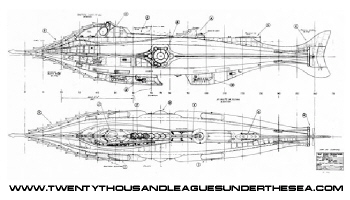 |
RETURN TO TWENTY THOUSAND LEAGUES UNDER THE SEA |
DOCUMENTATION THROUGH RESEARCH BY JAMES CLINTON CURRAN / DOCUMENTARY FILM HISTORIAN / ART DIRECTOR |
WWW.TWENTYTHOUSANDLEAGUESUNDERTHESEA.COM / COPYRIGHT 2005~ALL RIGHTS RESERVED~ |